How to Manage Anger After a New Diagnosis?

You might feel angry or overwhelmed after a new diagnosis. It’s normal. Many people say things like, “Leave me alone!” or “I can’t face this!” and show body language like slumped shoulders or crossed arms.
Patient Statements | Body Language |
|---|---|
“Leave me alone!” | Slumped over, arms crossed, crying |
You may also feel a sense of urgency or mental overload. Anger Management for the Newly Diagnosed helps you find support and practical steps.
Key Takeaways
Recognize that feeling angry after a diagnosis is normal. Accepting your anger can lead to improved self-esteem and better decision-making.
Identify your anger triggers by journaling and reflecting on your emotions. Understanding what sets off your anger helps you manage it more effectively.
Express your anger in healthy ways. Activities like exercise, journaling, and mindfulness can help you release tension and cope with your feelings.
Recognize and Accept Anger

Why Anger Happens
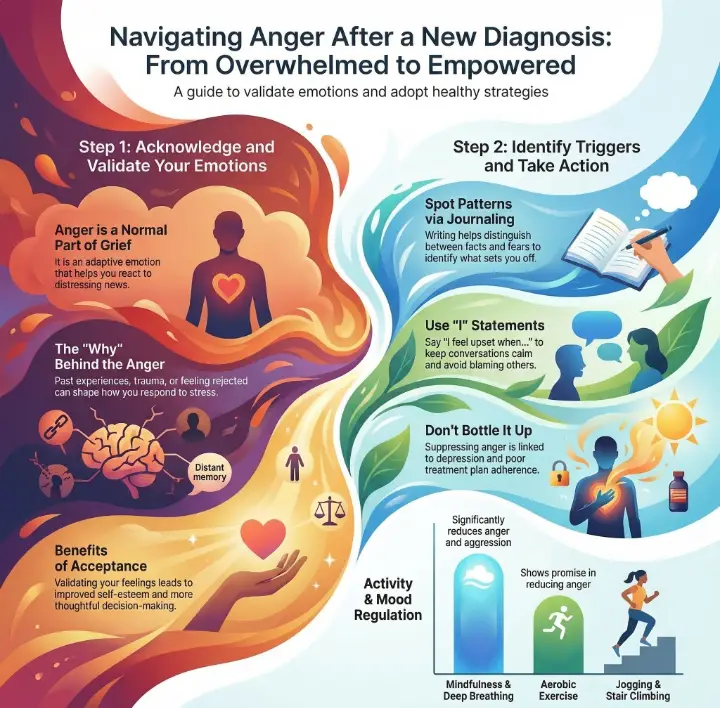
You might wonder why anger shows up after a new diagnosis. Anger is a universal emotion. It helps you react to distressing news and protects you from feeling overwhelmed. Different psychological theories explain anger in unique ways. Some focus on how your past experiences shape your response. Others look at how your thoughts and beliefs affect your feelings. Anger can be helpful or harmful, depending on how you handle it.
Anger is a primary emotion with adaptive functions.
Psychodynamic and cognitive-behavioral theories explore anger’s complexity.
Your personal history and relationships influence how anger appears.
Anger Management for the Newly Diagnosed starts with understanding these feelings. You are not alone. Many people feel angry, anxious, or scared after hearing tough news.
Validating Your Feelings
You may feel like your anger is wrong or out of place. It’s not. Anger is a normal part of the grieving process. It helps you cope and adjust. Sometimes, you might direct anger at yourself or others, but it’s really part of your healing. Support groups can help you process these emotions.
Mental health professionals recommend a few ways to validate your feelings:
Explore what triggers your anger.
Use reflective listening to feel heard and understood.
When you acknowledge and accept your anger, you gain benefits:
Benefit | Description |
|---|---|
You feel more confident and ready to handle tough situations. | |
Better decision making | You avoid rash choices and respond thoughtfully. |
Increased productivity | You manage stress and anxiety, which helps you get more done. |
You can move forward by accepting your emotions. This is a key step in Anger Management for the Newly Diagnosed.
Identify Triggers and Patterns
Common Triggers
You might notice your anger feels stronger in certain situations. Sometimes, your environment or the people around you can make these feelings worse. Growing up in a home with yelling or aggressive behavior can shape how you react to stress. If you experienced trauma or rejection, you may find anger comes up quickly. These triggers often come from your past, but they can also appear in your daily life.
Children who see violence may copy those anger patterns.
Trauma can make it hard to control emotions.
Feeling rejected by others can spark anger.
You can start to spot these triggers by paying attention to your reactions. When you know what sets you off, you can take steps to manage your anger. Anger Management for the Newly Diagnosed encourages you to look for patterns in your feelings.
Journaling and Self-Reflection
Journaling gives you a safe space to explore your emotions. You can write down what happened, how you felt, and what you thought. This helps you see the difference between facts and fears. When you keep track of your thoughts, you may notice certain situations or words make your anger worse.
Tip: Try writing about your day each evening. You might spot patterns you missed before.
It lets you process emotions in a healthy way.
You can find clear paths forward when you see your feelings on paper.
Self-reflection builds your self-awareness. You learn to recognize your triggers and manage your responses. This makes it easier to handle tough moments after a new diagnosis.
Anger Management for the Newly Diagnosed: Coping Strategies

Healthy Expression
You might feel like anger is something you should hide. That’s not true. Expressing anger in a healthy way helps you move forward. Anger Management for the Newly Diagnosed encourages you to find safe ways to let your feelings out. You can try several methods:
Exercise. Go for a walk, play a sport, or dance. Moving your body can turn anger into energy.
Write in a journal. Put your thoughts on paper. This gives you a private space to process your feelings.
Sing or dance. Music and movement can help you release emotions in a fun way.
Use ‘I’ statements. Say, “I feel upset when…” instead of blaming others. This keeps conversations calm.
Consider professional support. If anger feels too big, a counselor or therapist can help.
Tip: Don’t bottle up your anger. Studies show that suppressing anger can lead to depression and trouble following treatment plans.
Study | Findings |
|---|---|
Koh et al., 2002 | Anger expression is linked to depressive disorders. |
Erwin et al., 2003 | Anger suppression correlates with higher psychosocial impairment. |
Baker et al., 2004 | Dysregulated anger is associated with severity in PTSD, SAD, and PD. |
Foa et al., 1995 | More anger issues before treatment lead to less benefit from therapy. |
Physical Outlets
Your body holds tension when you feel angry. Physical activity helps release that tension. Anger Management for the Newly Diagnosed recommends trying different activities to see what works for you.
Effect on Anger and Mood | |
|---|---|
Mindfulness | Significantly reduces anger and aggression |
Deep Breathing | Effective in reducing anger |
Meditation | Helps manage anger and improve mood |
Team Sports (e.g., soccer) | Can help reduce anger |
Aerobic Exercise | Shows promise in reducing anger |
Jogging | Mixed effects; can worsen anger for some |
Stair Climbing | Sometimes worsens anger |
You can start with simple activities. Try walking, stretching, or playing a team sport. If you like music, dance in your room. If you want to calm down quickly, use deep breathing. The 4-4-4 method works well: inhale for four counts, hold for four counts, and exhale for four counts.
Note: Not every activity works for everyone. If jogging or stair climbing makes you feel worse, switch to something else.
Mindfulness and Timeouts
Mindfulness helps you notice your feelings without judging them. Anger Management for the Newly Diagnosed suggests using mindfulness to calm your mind and body. You can try these techniques:
Guided meditation. Listen to a recording or follow a script.
Progressive muscle relaxation. Tighten and release muscles to let go of tension.
Deep breathing. Focus on your breath to slow down your thoughts.
Mindfulness practices. Pay attention to your senses and surroundings.
When you feel anger rising, take a timeout. Step away from the situation. Give yourself a few minutes to breathe and think. This pause helps you avoid saying or doing something you might regret.
Callout: Mindfulness, deep breathing, and meditation work well whether you use an app, join a group, or talk to a therapist.
Seeking Support
You don’t have to handle anger alone. Anger Management for the Newly Diagnosed highlights the importance of support systems. Family, friends, and healthcare providers can help you feel understood and less isolated.
Social support. Talk to someone you trust. Share your feelings and listen to theirs.
Healthy distractions. Go hiking with friends or join a yoga class. These activities help shift your focus.
Support groups. Meet others who are going through similar experiences. You can learn new coping skills and feel less alone.
Healthcare providers. Doctors and therapists can teach de-escalation techniques and set clear boundaries. They listen and help you understand your anger.
Tip: If you feel overwhelmed, reach out to a professional. Cognitive-behavioral therapy and dialectical behavior therapy both help reduce distress and teach lasting skills.
You might notice that cultural factors shape how you express anger. Some people feel comfortable talking about their feelings. Others prefer to keep things private. Healthcare providers can help you find the best approach for your situation.
Anger Management for the Newly Diagnosed gives you tools to express, release, and manage anger. You can try different strategies and see what fits your life. Remember, you’re not alone. Support and practical steps are always available.
You can manage anger after a new diagnosis by following these steps:
Use behavioral techniques like taking a timeout or walking away.
Understand your triggers and warning signs.
Practice self-compassion and patience.
Benefit | How It Helps |
|---|---|
Emotional Recovery | Less distress, more hope |
Resilience | Stronger coping skills |
You’re not alone—support and new strategies can help you heal.
FAQ
What if I feel angry every day after my diagnosis?
You might feel angry often. Try journaling or talking to someone you trust. If anger stays strong, reach out to a counselor.
Can anger affect my health or treatment?
Yes, anger can make stress worse and impact your treatment. You can manage anger with exercise, mindfulness, or support groups.
How do I talk to family about my anger?
Start with “I feel…” statements. You can share your feelings calmly. Ask for support or just someone to listen.
Tip: Practice before you talk. It helps!
This article is for educational purposes only and is not a substitute for professional medical advice. For more details, please see our Disclaimer. To understand how we create and review our content, please see our Editorial Policy.
See Also
Understanding Angioimmunoblastic T-Cell Lymphoma Post-Diagnosis
Recognizing Symptoms and Treatments for Choroid Plexus Carcinoma
Key Symptoms and Treatment Options for Conjunctival Melanoma
Essential Symptoms and Treatment Guidance for LGL Leukemia
Essential Information on Symptoms of Adrenocortical Carcinoma

© 2026 Banish Cancer. Banish Cancer is a registered non-profit organization providing evidence-based research, educational courses, and Fear Response AI support services. Reg. No: 305706884 | Address: Taikos pr. 43-603, Kaunas, Lithuania.