How Smart Technology Is Revolutionizing Diagnostic Accuracy in Healthcare

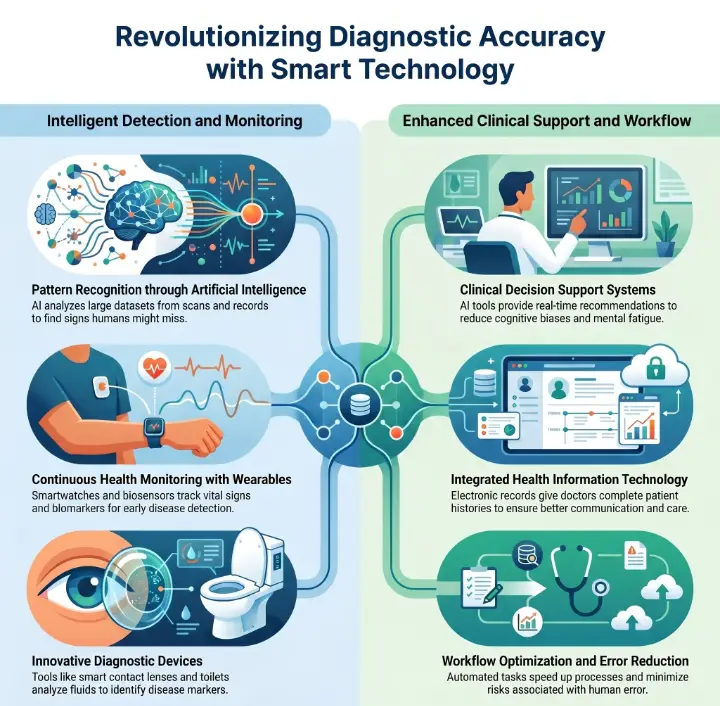
Every year, diagnostic errors affect over 12 million Americans and cost more than $100 billion. You can see how smart technology changes this reality. AI, machine learning, and smart sensors now help doctors make more accurate decisions and keep patients safer. These tools spot diseases early, reduce human mistakes, and improve your care.
Application | Description | Impact |
|---|---|---|
Early Detection of Infections | AI and ML algorithms find infections sooner. | Better prediction helps prevent outbreaks. |
Hand Hygiene Monitoring | Computer vision tracks hand hygiene in hospitals. | Studies show AI‑assisted monitoring can significantly improve hand‑hygiene compliance. |
Diagnosis of Conditions | AI analyzes data to diagnose illnesses like pneumonia. | More accurate and faster diagnoses. |
You benefit directly from Combating Diagnostic Errors with Smart Technology, as it leads to safer and more precise healthcare.
Key Takeaways
Smart technology, including AI and machine learning, significantly reduces diagnostic errors, leading to safer healthcare for patients.
Wearable devices and smart sensors provide continuous health monitoring, allowing for early detection of diseases and timely interventions.
Clinical decision support systems enhance doctors' decision-making by providing real-time, evidence-based recommendations, improving diagnostic accuracy.
Health information technology systems streamline communication and data access, ensuring doctors have the complete patient history for better care.
AI tools can analyze large datasets quickly, improving the speed and accuracy of diagnoses, ultimately leading to better health outcomes.
Smart Technology in Healthcare
AI and Machine Learning
You see AI and machine learning changing how doctors diagnose diseases. These tools analyze huge amounts of data from scans, lab results, and patient histories. AI finds patterns that humans might miss. You benefit when AI detects early signs of cancer or diabetes. Machine learning improves risk assessments by connecting symptoms and test results.
AI reduces false positives in medical imaging.
Early detection of abnormalities, such as tumors, leads to better outcomes.
AI applications in lung cancer screening and diabetes management show improved accuracy.
Diagnostic Tool | Accuracy Rate | Traditional Method Accuracy | Notes |
|---|---|---|---|
AI-based cancer diagnostics | In some studies, AI matches or exceeds specialist performance | Traditional accuracy varies by cancer type and imaging method | AI improves early‑stage detection in several validated trials |
AI for Alzheimer's detection | Earlier and more sensitive | Standard imaging | Enhanced imaging and biomarker analysis |
AI in diabetes diagnostics | Up to 90% | Varies | Robust across clinical settings |
AI for lung nodule detection | AI systems show higher sensitivity than traditional methods | Traditional accuracy varies | AI assists radiologists in detecting small nodules earlier |
Smart Sensors and Devices
Smart sensors and devices help you monitor your health every day. Wearable devices like smartwatches track your heart rate and blood pressure. Smart contact lenses check your glucose levels. Smart toilets analyze bodily fluids and detect disease markers.
Continuous glucose monitors alert you and your doctor about abnormal blood sugar.
Skin sensors on wearables spot early signs of infection.
Smartwatches detect irregular heart rhythms.
Wearable devices use biosensors to find biomarkers for cancer or infectious diseases. Sweat sensors measure chloride and glucose levels, helping diagnose cystic fibrosis and diabetes. You get early warnings and better control over your health.
Health Information Technology Systems
Health information technology systems support accurate and timely diagnoses. Electronic health records (EHRs) give doctors complete patient information. Clinical decision support systems offer real-time recommendations.
EHRs identify and correct problems quickly.
They provide clinical alerts and reminders.
AI and patient data analytics flag inconsistencies and suggest possible conditions.
Studies show EHRs improve health quality and reduce errors. You benefit from better communication between doctors and faster access to your medical history. Combating Diagnostic Errors with Smart Technology relies on these systems to keep you safe and informed.
Combating Diagnostic Errors with Smart Technology
Early Detection
You can spot health problems sooner with smart technology. Wearable devices like smartwatches and fitness trackers monitor your heart rate, blood pressure, and glucose levels. These tools alert you to changes that may signal disease. For example, a smartwatch can warn you about irregular heartbeats. Continuous glucose monitors help you manage diabetes without finger pricks. Biosensors test for infectious diseases and cancer markers at home. Early detection means you get treatment faster and avoid complications. Combating Diagnostic Errors with Smart Technology gives you and your doctor more information to make better decisions.
Heart rate monitoring alerts you to possible cardiac issues.
Blood pressure measurement helps find hypertension early.
Glucose monitoring supports diabetes management.
Biosensors identify disease markers quickly and accurately.
Smart sensors improve safety for older adults by tracking health and sharing insights with caregivers.
Pattern Recognition
AI and machine learning help you and your doctor find patterns in your health data. These systems analyze large datasets from scans, lab tests, and medical records. AI can detect tumors in radiology images with high accuracy. It matches complex patterns that humans may miss. You benefit when AI finds signs of disease before symptoms appear. AI learns from health records and medical literature, surfacing likely conditions based on your data. Combating Diagnostic Errors with Smart Technology means fewer missed diagnoses and more precise care.
AI detects diseases from medical imaging with accuracy rates up to 87%.
FDA has approved over 30 AI algorithms for diagnosis.
Deep learning matches the skill of health professionals in finding disease.
AI acts as a second mind in the exam room, suggesting possible diagnoses in real time.
Clinical Decision Support
Clinical decision support systems guide your doctor with evidence-based recommendations. These tools use AI to analyze your health information and suggest diagnoses. They help reduce cognitive biases, which are mistakes caused by mental shortcuts. Multi-agent frameworks, including large language models, improve diagnostic accuracy by examining possible diagnoses and identifying biases. You get safer care because your doctor receives real-time advice. Combating Diagnostic Errors with Smart Technology helps doctors make informed choices and avoid errors.
Real-time decision support provides evidence-based recommendations.
AI reduces cognitive overload and mental fatigue.
Integrated systems flag inconsistencies and suggest conditions.
Research shows that clinical decision support systems enhance patient care by reducing diagnostic mistakes.
Workflow Optimization
Smart technology streamlines the way your doctor works. Automated tasks speed up processes and minimize human error. Standardized communication improves clarity and reduces misunderstandings. Performance measurement identifies areas for improvement, making diagnosis more efficient. Combating Diagnostic Errors with Smart Technology ensures you get timely answers and fewer missed or delayed results.
Evidence Point | Description |
|---|---|
Standardized Communication | Improves clarity and reduces diagnostic errors |
Automated Tasks | Speeds up processes and minimizes human error |
Performance Measurement | Finds inefficiencies and optimizes diagnostic workflow |
Standardized handoffs and protocol refills lead to faster answers.
Reducing cognitive burden enhances clinical safety.
Missed or delayed results can damage trust and increase risks.
Workflow optimization protects you from delayed, missed, or incorrect diagnoses.
Real-World Impact and Examples
AI has already transformed many diagnostic processes. For example, the AI tool CHIEF, developed through Harvard Medical School, achieves an accuracy rate of 94% for cancer detection. It outperforms traditional methods and helps doctors identify cancers earlier, increasing treatment success. Similarly, Microsoft’s InnerEye project focuses on tumor detection, attaining an 87% sensitivity rate, surpassing many human radiologists. These tools reduce variability in interpretations, leading to more reliable diagnoses.
AI enhances radiology by analyzing imaging data rapidly and with high precision. This capability allows for earlier detection of diseases such as lung cancer and neurological disorders. In fact, AI algorithms now analyze diverse data sources—including imaging, blood tests, and genetic information—to improve early diagnosis across many medical conditions.
Wearable devices also contribute significantly to improved diagnostics. Smartwatches monitor vital signs like heart rate and blood pressure continuously. They detect irregularities such as arrhythmias or hypertension, alerting you promptly. Wearables with biosensors can even track glucose levels non-invasively, aiding diabetes management, while fall detection sensors enable rapid response for older adults. These tools enable continuous health monitoring and early disease detection, often leading to better health outcomes.
Innovative diagnostic devices like smart contact lenses and smart toilets play a crucial role too. Smart contact lenses can monitor glucose levels by analyzing tears, providing real-time data to detect issues early. Smart toilets automatically collect and analyze stool and urine samples to identify disease markers linked to colorectal or urological cancers. Such devices provide actionable insights for early intervention. Smart toilets, in particular, analyze defecation patterns and stool consistency, creating comprehensive health profiles that can reveal subtle changes in gastrointestinal and metabolic health, prompting timely medical attention.
Overall, smart technology’s application in healthcare not only improves diagnostic precision but also enables proactive health management. They reduce diagnostic errors by analyzing large datasets quickly, offering more consistent and accurate results. These real-world applications exemplify how the ongoing evolution in smart diagnostics enhances patient safety and care quality.
Challenges and Considerations
Data Privacy
You trust healthcare providers with your most sensitive information. Smart diagnostic technology relies on AI systems that process large amounts of patient data. This creates new risks for data privacy. Nearly 200,000 healthcare data breaches happen each year, and patient records are often the main target. When you use smart devices or AI-powered tools, your health data becomes more vulnerable to unauthorized access. Current laws like the GDPR and HIPAA do not fully protect you from the unique risks of AI. These regulations were not designed for the way AI uses and shares data. You may also worry about who is responsible if an AI system misuses your information. Some experts suggest solutions like federated learning, which keeps your data on your device, but more research is needed to prove these methods work well in healthcare.
Protecting your privacy is essential as smart technology becomes more common in healthcare.
Trust and Ethics
You want to know that AI tools in healthcare are fair and reliable. Building trust means making sure these systems work for everyone and do not introduce bias. Healthcare organizations use several strategies to address these concerns:
Description | |
|---|---|
Algorithmic Auditing | Regular checks for bias and performance across different groups. |
Transparent Documentation | Clear records of how AI systems work and their limitations. |
Human-in-the-Loop Design | AI supports, but does not replace, your doctor’s judgment. |
Continuous Learning | AI systems improve over time while keeping you safe. |
You benefit when doctors use AI as a second opinion, not as the only decision-maker. Clear documentation and regular audits help ensure that AI tools remain ethical and trustworthy.
Limitations
Smart technology in healthcare still faces important limits. You may notice delays in new tools because they need strict regulatory approval. Some doctors and patients hesitate to trust AI recommendations, which can slow adoption. Privacy and security concerns may also make you less confident in these tools. If AI systems use biased data, they could make healthcare disparities worse.
Limitation | Impact on Clinical Adoption |
|---|---|
Regulatory Approval | Slower rollout due to strict testing and approval. |
Clinician and Patient Trust | Hesitation to rely on AI, affecting acceptance. |
Privacy and Security | Worries about data safety may reduce confidence. |
Ethical and Bias Considerations | Risk of increasing disparities if AI is not fair to all groups. |
AI can help people in underserved areas, but only if everyone has access.
Some hospitals may not have the technology needed for smart diagnostics.
AI tools must work for all patients to avoid making health gaps wider.
You should always ask how new technology protects your privacy and supports fair care for everyone.
Patient Safety and Outcomes
Reducing Errors
You want your healthcare to be safe and accurate. Smart technology helps you by lowering the risk of mistakes during diagnosis and treatment. Hospitals now use AI and sensors to catch errors before they harm you. These tools can spot problems that people might miss. For example, AI can check if a doctor forgets a surgical instrument or prescribes the wrong medicine. Machine learning reviews sensor data and finds patterns that signal danger.
Smart hospital AI helps prevent medical errors, which cause about 250,000 deaths each year in the U.S.
AI and sensors catch mistakes like missing surgical tools or incorrect drug prescriptions.
Machine learning algorithms analyze your health data and alert doctors to possible risks.
Clinical Decision Support systems have reduced diagnostic errors by 25-33%.
AI-augmented systems reach 94% diagnostic accuracy, compared to 75% with older methods.
Studies show AI tools can cut errors by 25-30% across many types of care.
When your doctor uses smart technology, you get safer care and fewer mistakes.
Improving Health Outcomes
Smart technology does more than just reduce errors. It also helps you get better results from your healthcare. AI-driven diagnostics can find diseases early, even before you feel sick. This means you can start treatment sooner and have a better chance of recovery. Smart systems also help doctors create treatment plans that fit your needs.
Benefit | Description |
|---|---|
Improved Diagnostics | AI finds diseases like cancer and sleep disorders early and accurately. |
Personalized Treatment | AI reviews your data to suggest treatments made just for you. |
Workflow Optimization | Smart tools help doctors work faster and make fewer mistakes. |
You see these benefits in real life. AI systems now detect early signs of cancer in 19 different types. Tools for Alzheimer’s disease can spot risks with up to 90% accuracy using simple tests. In diabetes care, AI predicts who might get sick before symptoms appear. These advances mean you get care that is faster, safer, and more effective.
Smart technology gives you a better chance at a healthy future.
You see smart technology changing how doctors find and treat diseases. Digital tools like electronic records and clinical decision support systems help reduce mistakes and keep you safer. These systems give doctors better information and help them act quickly. In the future, smart hospitals and AI will make care even more accurate. You will benefit from early warnings, personalized treatment, and better health outcomes.
AI will help doctors spot problems early.
Smart hospitals will lower the risk of errors.
Predictive tools will guide your care.
You can look forward to a future where smart technology makes healthcare safer and more effective.
FAQ
What is smart technology in healthcare?
Smart technology uses tools like AI, machine learning, and sensors to help doctors find diseases. You get faster and more accurate results. These tools can watch your health and alert you to problems early.
How does AI help reduce diagnostic errors?
AI reviews your health data and finds patterns that doctors might miss. You get safer care because AI can spot mistakes and suggest better diagnoses. This means fewer missed or wrong diagnoses for you.
Are smart devices safe for my health data?
Most smart devices use strong security to protect your information. You should check if your device follows privacy rules like HIPAA. Always ask your doctor or device maker about how they keep your data safe.
Can smart technology replace my doctor?
Smart technology supports your doctor but does not replace them. You still need a doctor to make final decisions. AI and sensors give your doctor better information so you get the best care.
This article is for educational purposes only and is not a substitute for professional medical advice. For more details, please see our Disclaimer. To understand how we create and review our content, please see our Editorial Policy.
See Also
Insulinoma: Key Insights and Its Importance Explained
Recognizing Duodenal Cancer: Symptoms and Available Treatments
Endodermal Sinus Tumors: Symptoms and Diagnostic Insights
Conjunctival Melanoma: Key Symptoms and Treatment Options
Glioblastoma: Essential Characteristics and Understanding Its Impact

© 2026 Banish Cancer. Banish Cancer is a registered non-profit organization providing evidence-based research, educational courses, and Fear Response AI support services. Reg. No: 305706884 | Address: Taikos pr. 43-603, Kaunas, Lithuania.