Effective Use of Technology in Public Health Made Simple

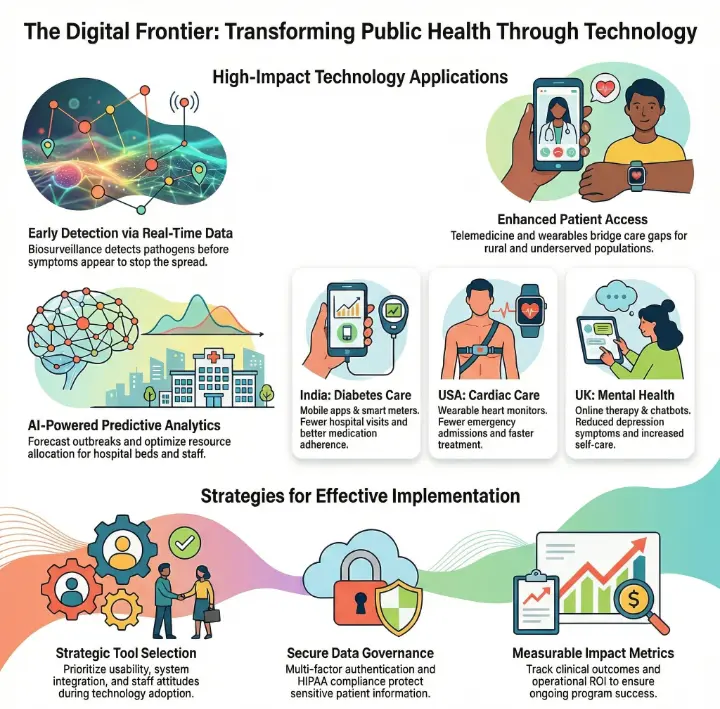
You see technology change the way public health works every day. Real-time monitoring lets health agencies act faster during emergencies, cutting response times. Predictive analytics help experts manage diseases and make smarter decisions. Digital health tools give you better access to care and empower you to take charge of your health.
Real-time data tools enable swift CDC actions, reducing response times.
Big data analytics improve health outcomes and decision-making, as shown by global studies.
Benefit | Description |
|---|---|
Improved Efficiency | AI allocates resources efficiently, optimizing beds, staff, and equipment. |
Cost Reduction | Automation lowers operational costs. |
Enhanced Diagnostic Accuracy | AI enables earlier detection and better treatment options. |
Better Accessibility | Personalized plans improve outcomes and ease financial burdens. |
Predictive Analytics | AI forecasts outbreaks for timely responses. |
You can help your community by understanding and using the Effective Use of Technology in Public Health.
Key Takeaways
Real-time monitoring helps detect disease outbreaks quickly, allowing health teams to respond faster and prevent the spread.
Digital health tools empower you to manage your health better, providing access to care and personalized health information.
Telemedicine increases healthcare access, especially for those in rural areas, reducing travel and improving patient engagement.
Data analytics supports better decision-making in public health, helping to allocate resources effectively and improve health outcomes.
Wearable devices and mobile health apps provide real-time health data, enabling proactive management of chronic diseases and enhancing patient care.
Effective Use of Technology in Public Health
Real-Time Monitoring & Early Detection
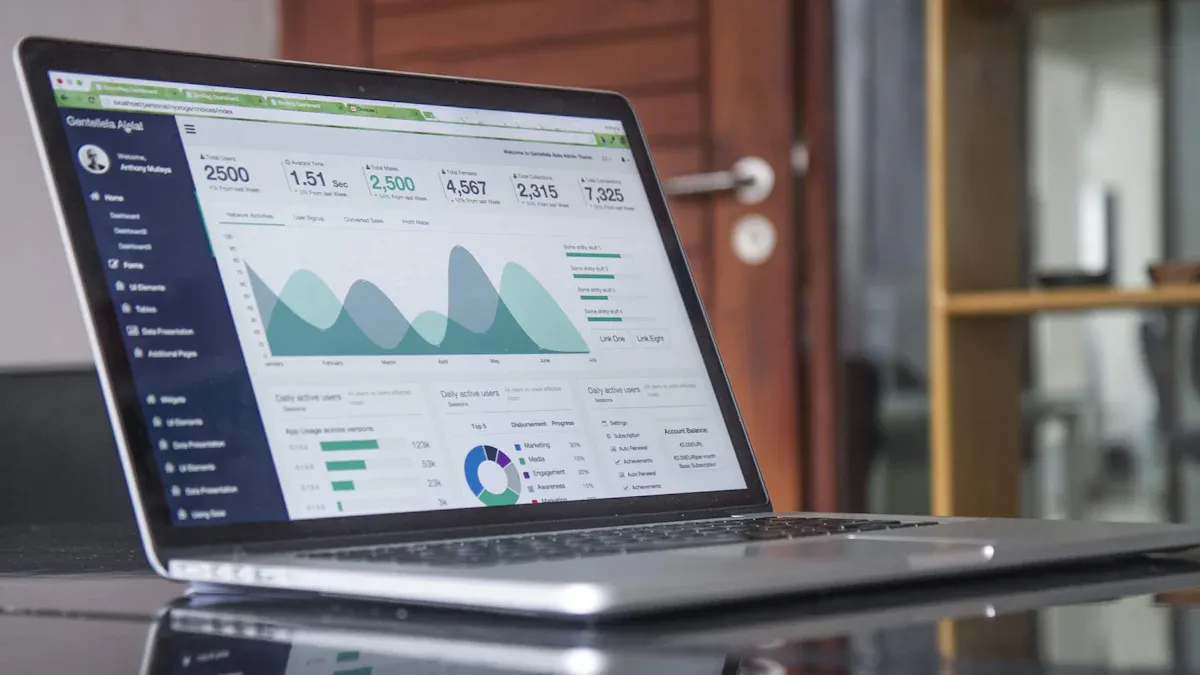
You can see how real-time monitoring changes public health every day. This technology helps you spot disease outbreaks quickly. For example, biosurveillance and wastewater monitoring let health officials find pathogens before people show symptoms. When you use real-time data, you help public health teams act fast and stop diseases from spreading.
Ontario, Canada used emergency department data to track respiratory diseases. This approach showed that real-time monitoring reflects community health trends and helps detect outbreaks early.
Early detection leads to faster responses, like starting vaccination campaigns or setting travel restrictions.
Real-time data helps officials make decisions right away.
Teams can send resources to areas at risk, improving outbreak control.
Digital surveillance tools also map infectious disease risks almost instantly. Reliable, real-time data streams are essential for risk assessments and outbreak management. The Effective Use of Technology in Public Health means you can protect your community by acting before problems grow.
Health Education & Communication
You play a key role in health education when you use digital platforms. The CDC uses digital campaigns to reach target audiences. These campaigns include health communication and social marketing materials that show successful strategies.
Digital platforms help you share health information quickly and widely.
You can use videos, social media, and websites to teach people about healthy habits.
Exploring these resources helps you create effective health promotion materials.
Initiative | Measurable Outcomes |
|---|---|
Improved treatment planning efficiency and stronger adherence to clinical guidelines. | |
Google DeepMind | Achieved diagnostic accuracy comparable to expert ophthalmologists, enabling better prioritization of cases. |
Mayo Clinic AI Initiatives | Enhanced patient survival rates through predictive analytics and reduced wait times for diagnosis. |
AI applications in medical education improve curriculum design and clinical training. Personalized learning systems support individual growth. Virtual simulations let you practice diagnostic reasoning. The Effective Use of Technology in Public Health empowers you to educate and inform your community.
Data-Driven Decisions
You can make better choices in public health by using data analytics. Hospitals analyze patient flow and treatment needs to optimize resources and reduce waiting times. Real-time data analysis helps experts spot epidemics through ER visits and social media trends.
Data-driven decision-making supports evidence-based planning.
Digital citizen science promotes health equity.
Rapid responses to crises become possible with real-time data.
Social innovation focuses on technology decentralization and data security.
Intervention Strategy | Effectiveness in Achieving Policy Goals |
|---|---|
Behavioral Risk Reduction | Unlikely to achieve goals |
Antiretroviral Treatment Initiation and Adherence Support | Most likely to achieve goals |
Predictive analytics uses large datasets to forecast health outcomes. It identifies risk factors and helps allocate resources. Models simulate complex environments for health interventions. These tools refine research agendas, especially in places with limited resources. Health data analytics gives you insights into population health trends and disparities. The Effective Use of Technology in Public Health lets you improve outcomes for both individuals and communities.
Remote Care & Telemedicine
You can increase access to healthcare by using telemedicine and remote care. Telemedicine reduces no-show rates for appointments, showing improved patient engagement. In chronic disease management, especially diabetes care, telemedicine leads to better health outcomes and cost savings.
Telemedicine removes the need for long-distance travel, helping patients in rural areas.
Remote patient monitoring bridges gaps in healthcare access for underserved populations.
Continuous monitoring encourages early interventions, reducing risks of complications.
Virtual visits expand access to care, especially for those facing transportation and financial barriers.
Benefit | Description |
|---|---|
Improved Access to Care | Remote patient monitoring (RPM) bridges gaps in healthcare access for underserved populations. |
Better Chronic Disease Management | RPM enables effective management of chronic conditions like diabetes and hypertension. |
Reduced Emergency Visits | RPM helps in early detection of health issues, leading to fewer emergency room visits. |
Enhanced Patient Engagement | Patients are more involved in their health management through continuous monitoring. |
Support for Healthcare Providers | RPM allows providers to focus on high-risk patients while automating routine tasks. |
Telehealth became essential during the COVID-19 pandemic. Providers delivered high-quality care outside traditional settings. The Effective Use of Technology in Public Health helps you overcome barriers and reach more people.
Mobile Health & Wearables
You can manage chronic diseases better with mobile health apps and wearable devices. Wearables give you real-time health data and help clinicians understand your health. Continuous glucose monitors and telemonitoring technologies support timely interventions.
Research shows that mobile health apps help you make lifestyle changes. For example, diabetes patients improved medication adherence and health outcomes by using these apps. Wearables also detect disease flare-ups and support proactive management, reducing hospital admissions.
Wearable devices provide objective, data-driven insights for medical decisions.
They enable real-time health data collection and transmission.
Continuous tracking of vital signs allows immediate responses to critical health situations.
Wearables help identify health concerns early, preventing complications.
They are useful for managing chronic conditions by allowing remote monitoring of treatment effectiveness.
Wearable technology facilitates personalized health coaching and remote patient monitoring.
By reducing the need for in-person consultations, wearables lower healthcare costs and improve access to care.
Contribution Type | Description |
|---|---|
Enhanced Patient Engagement | Digital health tools improve patient engagement through innovative strategies and AI-driven workflows. |
Personalized Care | Tools must be customized to meet individual patient needs, leading to better health outcomes. |
Chronic Disease Management | Remote monitoring systems help manage chronic conditions effectively, reducing hospital admissions. |
Telecare Consultations | Nurse-led telecare programs show high feasibility and improve quality of life for stroke survivors. |
Chatbot Interventions | Chatbots provide scalable support for mental health, addressing stigma and manpower shortages. |
The Effective Use of Technology in Public Health gives you tools to monitor your health, stay engaged, and receive care wherever you are.
Real-World Applications
Outbreak Tracking
You can see how technology helps track outbreaks and protect communities. Contact tracers in Nigeria monitored almost 900 people during the 2014 Ebola outbreak. They made thousands of visits and contained the disease to only 19 cases in a city with millions. Go.Data helped manage diphtheria among refugees in Bangladesh and Ebola in Africa. The World Health Organization can send response teams within a day to stop outbreaks. AI-driven epidemic intelligence improves detection and response. It uses large language models and natural language processing to give early warnings. Modern surveillance systems monitor diseases in real time and spot problems quickly. Predictive modeling helps plan targeted interventions.
Contact tracing and digital tools help contain outbreaks.
AI speeds up detection and improves forecasting.
Real-time monitoring supports fast responses.
Telehealth for Rural Areas
You can use telehealth to reach doctors and specialists even if you live far from a hospital. Telehealth improves access to specialty care in rural hospitals. It helps patients during emergencies and reduces wait times for mental health care. Telehealth creates virtual networks for doctors, which lowers burnout and helps keep providers in rural areas. You save money and time because you do not need to travel long distances. Telehealth reduces barriers like lack of transportation and childcare. It also connects you with culturally competent providers.
Telehealth increases access and lowers costs.
Virtual care helps patients and providers in remote areas.
You get care without the hassle of travel.
Mobile Apps for Chronic Disease
You can manage chronic diseases better with mobile apps. These apps help you track your health and stick to treatment plans. Patients in India used a diabetes monitoring app and saw fewer hospital visits and better medication habits. AI-powered heart monitors in the USA helped prevent strokes and reduced emergency admissions. Virtual COPD management in Canada improved lung function and lowered healthcare costs. Online therapy and chatbots in the UK reduced depression symptoms and increased self-care.
Challenge | Telemedicine Solution | Impact | |
|---|---|---|---|
Remote Diabetes Monitoring in India | Limited access to specialists | Mobile app with smart glucose meters | Fewer hospital visits, better adherence |
AI-Powered Cardiac Care in the USA | Missed warning signs | Wearable heart monitors | Fewer emergencies, faster treatment |
Virtual COPD Management in Canada | Need for continuous monitoring | Smart inhalers, virtual rehab | Improved lung function, lower costs |
Tele-Psychiatry in UK | Lack of mental health services | Online therapy, AI chatbots | Less depression, more self-care |
Mobile health apps give you control over your care. You can book appointments, get reminders, and access test results. Two-way messaging lets you ask questions and share symptoms. The Effective Use of Technology in Public Health shows you how these tools make healthcare easier and more accessible.
Steps for Effective Implementation
Choosing the Right Tools
You need to select technology tools that fit your public health goals. Look at technical factors like usability, system performance, and reliability. Think about how well the tools work with your current systems. Social factors matter too. Consider how people feel about new technology and how much support they need. Organizational factors include planning, leadership, and teamwork. Wider factors involve policies, industry standards, and economic conditions.
Usability and adaptability
Integration with existing systems
Staff attitudes and motivation
Leadership and communication
Policy and economic environment
When you focus on these areas, you make the Effective Use of Technology in Public Health easier for your team.
Training & Adoption
You help your staff succeed by offering strong training programs. Use applied learning strategies like flipped classrooms and virtual reality. Mix problem-based and experiential learning methods. Tailor training to different skill levels. Provide support materials such as handouts and live help.
Description | |
|---|---|
Application | Use user-friendly tools like video calls. |
System Requirements | Ensure good internet and device memory. |
Training Adaptability | Adjust training for each user’s skills. |
Support Materials | Offer handouts and live support. |
Effective training boosts confidence and performance. Studies show that well-trained staff use technology better and faster. You see higher efficiency and lower onboarding times.
Privacy & Security
You protect patient data by addressing privacy and security challenges. Common issues include outdated IT systems, weak encryption, and gaps in cybersecurity. Regulatory protections often fall short.
Many challenges to health privacy are associated with data practices that are currently legal, highlighting the need for reform in how data is managed and protected.
Use strong strategies to keep data safe.
Strategy | Description |
|---|---|
Train staff to handle threats and protect data. | |
Cybersecurity Improvements | Use multi-factor authentication and update software. |
Access Control | Limit access to sensitive data and run regular audits. |
Compliance with Regulations | Follow HIPAA rules and encrypt data. |
Physical Safeguards | Secure data storage and access points. |
Measuring Impact
You measure the impact of technology by tracking key metrics. Clinical outcome metrics show improvements in patient health. Patient safety indicators reveal changes in medical errors. Operational metrics track staff productivity and resource use. Patient experience measurements capture satisfaction and engagement.
Clinical outcome and quality metrics
Patient safety indicators
Operational performance metrics
Patient experience and engagement measurements
You also assess return on investment by comparing benefits, expenses, and revenue impacts. Use standardized frameworks to evaluate financial returns and identify projects with the greatest value. The Effective Use of Technology in Public Health depends on careful measurement and ongoing improvement.
You see technology change public health for the better. Digital health solutions help you make faster decisions, improve care, and save money. You can use these tools to boost efficiency and support your community.
What You Gain | |
|---|---|
Clinical Association | Better health outcomes |
Analytical | Improved cost management |
Clinical Performance | Easier tool use |
Financial Benefits | Lower expenses |
Operational Benefits | Smoother workflows |
Experiential Benefits | Higher satisfaction |
You can lead the way by adopting digital health solutions. Start exploring new technologies and help your community stay healthy.
FAQ
What is digital health?
Digital health uses technology to improve your health. You can use apps, wearables, and online tools to track your health, talk to doctors, and learn about healthy habits.
How does technology help prevent disease outbreaks?
You can use real-time data and digital tools to spot outbreaks early. This helps health teams act fast and stop diseases from spreading in your community.
Are my health records safe with digital tools?
Most digital health tools use strong security measures like encryption and passwords. You should always choose trusted apps and follow safety tips to protect your information.
Can I use telemedicine if I live in a rural area?
Yes! Telemedicine lets you talk to doctors from home. You can get care without traveling far. Many rural clinics now offer video visits and remote checkups.
This article is for educational purposes only and is not a substitute for professional medical advice. For more details, please see our Disclaimer. To understand how we create and review our content, please see our Editorial Policy.
See Also
Simplifying B-Cell Prolymphocytic Leukemia For Better Understanding
Join Banish Cancer – A Place of Hope and Resilience
Recognizing Symptoms and Treatments for Conjunctival Melanoma

© 2026 Banish Cancer. Banish Cancer is a registered non-profit organization providing evidence-based research, educational courses, and Fear Response AI support services. Reg. No: 305706884 | Address: Taikos pr. 43-603, Kaunas, Lithuania.