Top Health Benefits of Iodine for Humans

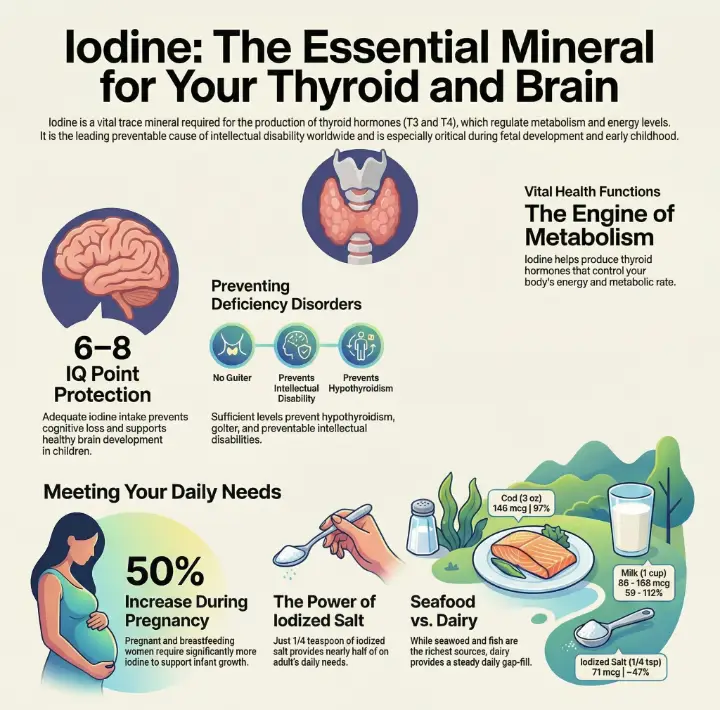
You gain many health benefits from iodine.
Iodine helps your body produce thyroid hormones that control metabolism and energy.
It supports your brain and nervous system, especially during fetal and infant development.
Iodine protects your cells from damage and helps prevent deficiency disorders, including hypothyroidism and intellectual disabilities.
Universal salt iodization improves iodine levels worldwide. You can see progress in the chart below:
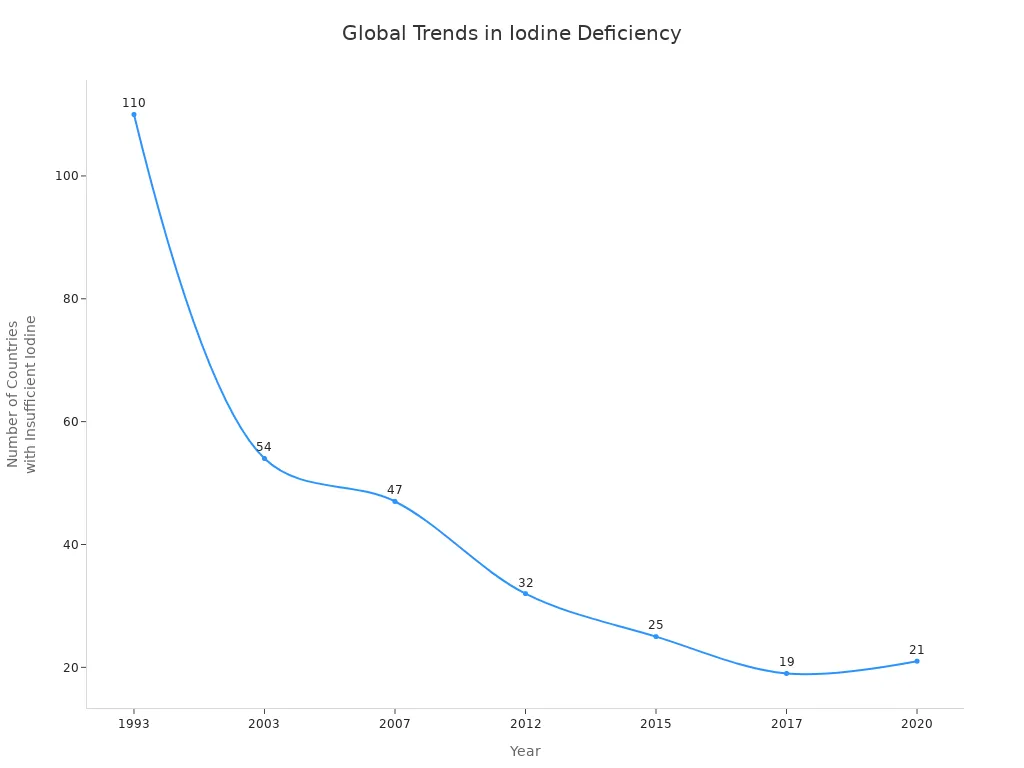
You should reflect on your own iodine mineral benefits humans and consider if you meet your daily needs.
Key Takeaways
Iodine is essential for producing thyroid hormones, which regulate metabolism and energy levels.
Adequate iodine intake supports brain development and cognitive function, especially in children.
Meeting daily iodine needs helps prevent disorders like hypothyroidism and goiter.
Include iodine-rich foods like seafood, dairy, and iodized salt in your diet for optimal health.
Consult your doctor before taking iodine supplements to avoid excess intake.
Iodine Mineral Benefits for Humans
Supports Thyroid Hormones
You depend on iodine to make thyroid hormones. These hormones control your metabolism and energy. Without enough iodine, your thyroid cannot work properly. You may feel tired, gain weight, or have trouble concentrating. The thyroid uses iodine in several steps to produce hormones. The process includes iodide uptake, oxidation, hormone formation, secretion, and regulation.
Mechanism | Description |
|---|---|
Iodide Uptake | Iodide moves into thyroid cells through a special transporter. |
Iodide Oxidation | Enzymes change iodide into active iodine. |
Hormone Formation | Iodine attaches to proteins and forms T4 and T3 hormones. |
Secretion | Thyroid hormones leave the gland and enter your blood. |
Regulation | Thyroid stimulating hormone (TSH) controls how much hormone your body makes. |
You need iodine for the synthesis of thyroid hormones T4 and T3. These hormones contain iodine atoms. If you do not get enough iodine, your thyroid gland cannot make enough hormones. This can lead to hypothyroidism and goiter. Iodine mineral benefits humans by keeping thyroid hormone levels normal and preventing these problems.
Boosts Brain and Cognitive Health
Iodine supports your brain and learning abilities. Thyroid hormones help your brain grow and develop, especially when you are young. They guide the formation of white matter, which is important for thinking and memory. Thyroid hormones also help your brain cells connect and communicate.
Research shows that iodine mineral benefits humans by improving cognitive function. Children who get enough iodine score higher on IQ tests. Studies found that children with moderate iodine deficiency had lower IQ scores than those with adequate iodine intake.
Group | IQ Score Range | |
|---|---|---|
Moderate Iodine-Deficient | 86.67 | Low Average (80-89) |
Adequate Iodine Intake | 101.80 | Normal Average (90-109) |
Iodine deficiency can cause severe mental and developmental problems. Children under five may lose around 6–8 IQ points in populations with low iodine intake. Many newborns in Europe are at risk because they do not get enough iodine.You can protect your brain health by making sure you get enough iodine.
Prevents Iodine Deficiency Disorders
You avoid many health problems when you meet your iodine needs. Iodine mineral benefits humans by preventing disorders like hypothyroidism, goiter, and intellectual disabilities. Hypothyroidism happens when your thyroid cannot make enough hormones. You may feel tired, cold, or have dry skin. Goiter is an enlarged thyroid gland caused by low iodine.
Disorder Type | Description |
|---|---|
Thyroid gland grows larger to try to capture more iodine. | |
Neurological Cretinism | Babies may have short stature, deafness, and muscle stiffness. |
Iodine deficiency is the leading preventable cause of intellectual disability worldwide. The global rates of these disabilities have dropped because more people use iodized salt. In 2021, the age-standardized prevalence rate for intellectual disability due to iodine deficiency was 8.96 per 100,000 people. You can help prevent these disorders by checking your iodine intake and choosing foods rich in iodine.
Tip: You can boost your health by including iodine-rich foods in your diet. Seafood, dairy, and iodized salt are good sources.
Iodine mineral benefits humans by supporting thyroid hormones, boosting brain health, and preventing deficiency disorders. You play an important role in protecting your health by making sure you get enough iodine every day.
Daily Iodine Needs
Intake by Age Group
You need different amounts of iodine at each stage of life. Health authorities set clear guidelines for daily intake. Infants require more iodine per kilogram than adults because their bodies grow quickly. Children and teenagers need enough iodine to support their development and metabolism. Adults use iodine to maintain thyroid function and energy.
Age Group | Recommended Daily Iodine Intake (µg/day) | Approximate Intake (µg/kg/day) |
|---|---|---|
Young infants (0-6 months) | 40 | 7.5 |
Older infants (6-12 months) | 50 | 7.5 |
Children (1-10 years) | 60-100 | 5.4 |
Adolescents and adults | 150 | 2 |
Pregnancy and lactation | N/A | 3.5 |
You should also know the safe upper limits for iodine intake. Too much iodine can cause thyroid problems. The chart below shows the upper limits for each age group.
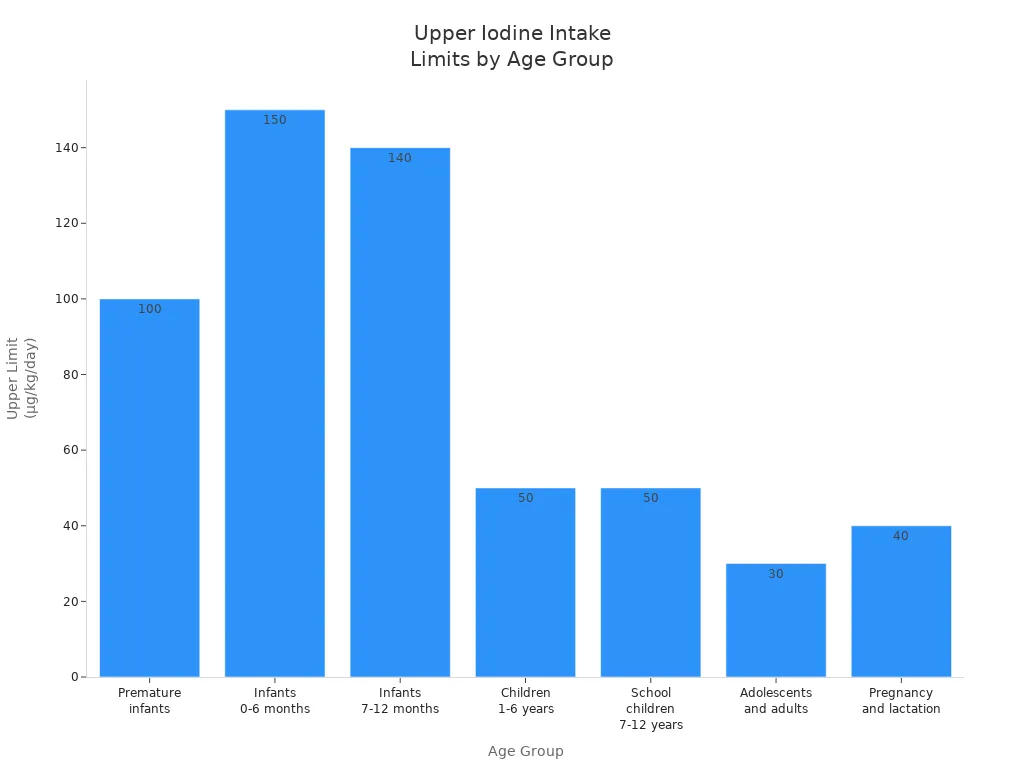
Tip: You can check food labels and supplements to make sure you do not exceed these limits.
Special Needs in Pregnancy and Breastfeeding
Pregnant and breastfeeding women need more iodine than other adults. Your body increases iodine use during pregnancy. You produce more thyroid hormones to support your baby’s growth. Your kidneys filter iodine faster, so you lose more in urine. You transfer iodine to your baby, especially after the baby’s thyroid starts working at about 12 weeks.
During breastfeeding, you send iodine into your milk to help your infant’s brain and body develop. Experts recommend about 220 µg/day during pregnancy and 250-290 µg/day while breastfeeding. This ensures your baby gets enough iodine for healthy growth.
Maternal iodine needs rise by about 50% during pregnancy.
Breastfed infants depend on iodine in breast milk.
Iodine helps prevent cognitive and psychomotor problems in children.
Prenatal vitamins with iodine support these higher needs.
You protect your child’s health by meeting these needs. Iodine mineral benefits humans by supporting both mother and infant during these important stages.
Best Iodine Sources

Seafood and Dairy
You can find iodine in many foods, but seafood stands out as the richest source. Marine fish and shellfish absorb iodine from the ocean, so they contain high levels. For example, haddock gives you up to 227 micrograms of iodine per 100 grams. Cod also provides a large amount, with 146 micrograms in a 3-ounce serving. Shrimp and seaweed, like kombu kelp, offer even more. Kombu kelp contains almost 3,000 micrograms per gram, which is far above your daily needs.
Dairy products also help you meet your iodine requirements. Milk supplies between 88 and 168 micrograms per cup, depending on how farmers feed their cows and the season. Cottage cheese and cheddar cheese give you smaller amounts, but they still contribute to your daily intake. You can see the iodine content in common foods in the table below:
Food Source | Iodine Content (mcg) per Serving | % of Daily Value |
|---|---|---|
Cod (3 oz) | 146 | 97% |
Milk (1 cup) | 88 - 168 | 59 - 112% |
Cottage Cheese (1 cup) | 65 | 43% |
Cheddar Cheese (1 oz) | 12 | 8% |
Shrimp (3 oz) | 35 | 23% |
Kombu Kelp (1 g) | 2,984 | 2,000% |
Wakame (1 g) | 66 | 44% |
Nori (1 g) | 16 - 43 | 11 - 29% |
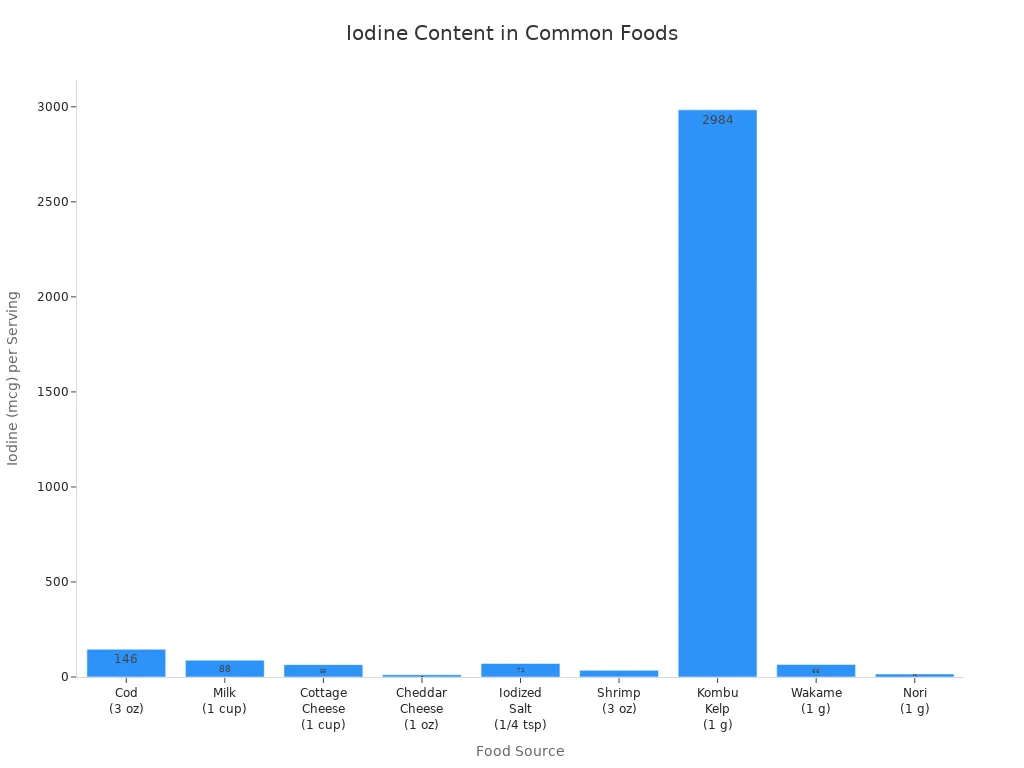
Note: Seafood usually contains more iodine than dairy. You can rely on fish and seaweed for a steady supply, but dairy helps fill the gap when seafood is not available.
Iodized Salt and Supplements
You can boost your iodine intake with iodized salt. Manufacturers add iodine to table salt to help prevent deficiency. One-quarter teaspoon of iodized salt gives you about 71 micrograms, which covers almost half your daily needs. Universal salt iodization is a safe and low-cost way to improve iodine nutrition worldwide.
Supplements also play a role, especially for people who cannot get enough iodine from food. Health experts recommend iodine tablets or drops for vulnerable groups, such as pregnant women or people living in areas with low iodine levels. You should use supplements carefully, because too much iodine can harm your thyroid.
Evidence Type | Summary |
|---|---|
Iodized Salt | Most common and effective method for preventing iodine deficiency. |
Iodine Supplements | Distributed to vulnerable populations in areas with widespread deficiency. |
Universal Salt Iodization | Recommended strategy for controlling iodine deficiency. |
Salt Iodization | Effective, safe, and low-cost method for preventing iodine deficiency. |
Iodine Supplementation | Effective in reducing iodine deficiency, but must be monitored. |
Tip: You can check food labels for iodized salt and talk to your doctor before using supplements. This helps you stay healthy and avoid excess iodine.
Iodine Risks and Deficiency

Signs of Deficiency
You may notice early signs if your body lacks iodine. These symptoms can affect your health and daily life. Watch for the following:
Hypothyroidism (underactive thyroid)
Weight gain
Sensitivity to cold
Dry skin and hair
Constipation
Mental and cognitive impairment
Memory problems
Depression
Infertility
Hoarseness
Puffy skin
If you see several of these symptoms, you should check your iodine intake. Iodine mineral benefits humans by preventing these problems and supporting healthy thyroid function.
Risks of Excess Intake
Too much iodine can harm your body. You may face health risks if you consume more than the recommended amount. Here are some possible effects:
Hyperthyroidism (overactive thyroid)
Autoimmune thyroid disease
Papillary thyroid cancer
Reduced thyroid hormone production
Goiter
Vascular injury and atherosclerosis
Elevated blood pressure and blood glucose
Impaired cognitive function in children
The upper tolerable intake levels for iodine depend on your age. You can see these limits in the table below:
Age Group | Upper Tolerable Intake Level (µg/day) |
|---|---|
1–3 years | 200 |
4–6 years | 250 |
7–10 years | 300 |
11–14 years | 450 |
15–17 years | 500 |
Adults | 1,100 |
Pregnant women | 1,100 |
Lactating women | 1,100 |
Some countries use slightly lower limits, but most major health authorities set the adult upper limit at 1,100 µg/day.
You should avoid taking large doses of iodine supplements unless your doctor recommends them.
Who Is at Risk?
Certain groups face a higher risk of iodine deficiency. You may belong to one of these groups if you live in a region with iodine-poor soil or follow a restricted diet.
People in mountainous areas or parts of Africa, South Asia, and Europe
Individuals who do not use iodized salt
People who avoid dairy, seafood, and eggs (such as vegans)
These values are approximate, since different studies report slightly different prevalence rates.
Population Group | Prevalence of Iodine Deficiency | Year |
|---|---|---|
Pregnant women in Michigan | 23% | Recent |
General population in Europe | 17% at risk of IDD | 2001 |
Women aged 16-49 in the UK | 17% | 2016-2018 |
General population in South East Asia | 36% | Recent |
General population in Eastern Mediterranean | 43% | Recent |
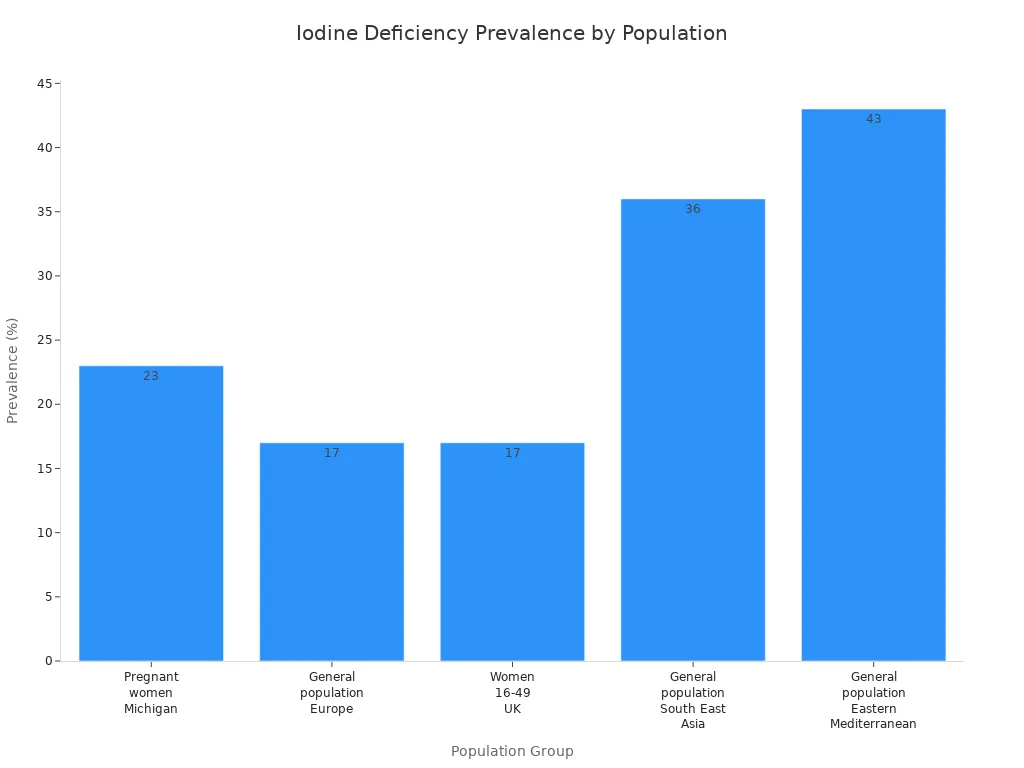
You can lower your risk by eating iodine-rich foods and using iodized salt. Iodine mineral benefits humans by protecting vulnerable groups from deficiency disorders.
You gain many health benefits from iodine.
Iodine supports thyroid function and hormone production.
It helps your brain develop before and after birth.
It maintains thinking and reasoning skills.
It prevents goiter and fibrocystic breast changes.
It disinfects skin wounds.
You need to meet your daily iodine needs without excess. Too little or too much iodine can cause health problems. You can use these strategies to keep your iodine levels healthy:
Strategy | Description |
|---|---|
Use iodized salt | Add iodized salt to meals, but limit sodium. |
Eat iodine-rich foods | Choose seafood, dairy, eggs, and seaweed. |
Be careful with supplements | Take iodine supplements only if your doctor recommends them. |
You should talk to your healthcare provider if you have questions about your iodine intake.
FAQ
What foods give you the most iodine?
Seafood, such as cod and shrimp, gives you high amounts of iodine. Dairy products, eggs, and iodized salt also help you meet your daily needs. Seaweed contains the most iodine, but you should eat it in moderation.
How do you know if you lack iodine?
You may notice symptoms like tiredness, weight gain, dry skin, or an enlarged thyroid gland. If you suspect a deficiency, you can ask your doctor for a blood test to check your thyroid hormone levels.
Can you get too much iodine from supplements?
Yes, you can get too much iodine if you take high-dose supplements. Too much iodine may cause thyroid problems. You should only use supplements if your doctor recommends them.
Why do pregnant women need more iodine?
Pregnant women need more iodine because their bodies make extra thyroid hormones for their babies. Iodine helps the baby’s brain and body grow. Doctors often suggest prenatal vitamins with iodine.
Is iodized salt safe for daily use?
Iodized salt is safe for most people. It helps prevent iodine deficiency. You should use it in moderation to limit sodium intake and protect your heart.
This article is for educational purposes only and is not a substitute for professional medical advice. For more details, please see our Disclaimer. To understand how we create and review our content, please see our Editorial Policy.
See Also
Understanding Insulinoma: Importance and Key Insights
Hodgkin's Lymphoma: Recognizing Symptoms and Key Information
Choroid Plexus Carcinoma: Symptoms and Treatment Options Explained
Exploring Various Types of Cancer: A Complete Guide
Islet Cell Carcinoma: Insights Into Endocrine Pancreas Health

© 2026 Banish Cancer. Banish Cancer is a registered non-profit organization providing evidence-based research, educational courses, and Fear Response AI support services. Reg. No: 305706884 | Address: Taikos pr. 43-603, Kaunas, Lithuania.