Why Do People Think Cancer Research Is Being Hidden?

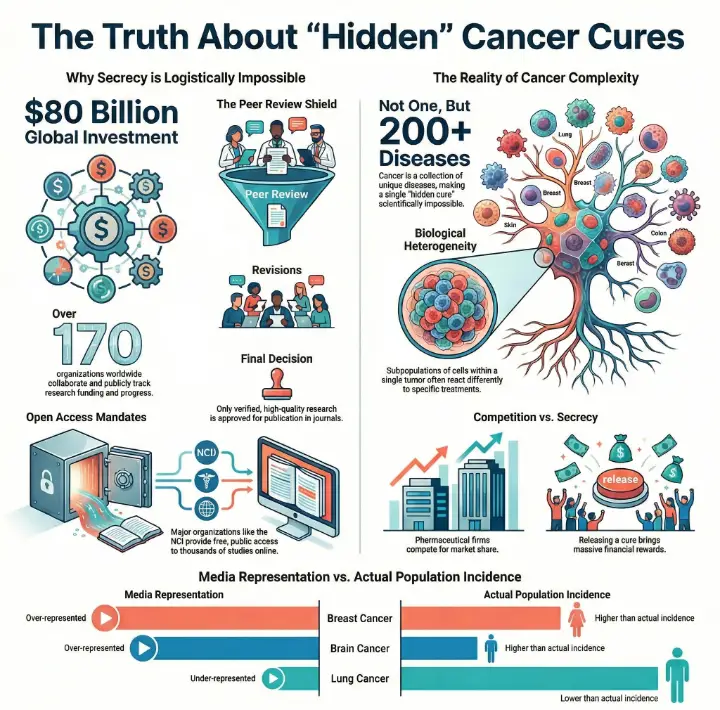
You might wonder, Is Cancer Research Already Censored or Hidden from the Public? Many people feel concerned about hidden cures or secret research. Some believe profit motives drive pharmaceutical companies, while others see misinformation or media stories as reasons for doubt. Cancer involves over 200 diseases, so finding one cure is unlikely. Research includes thousands of experts worldwide, making it almost impossible to keep discoveries secret. The scale and investment in cancer research show that hiding progress does not make sense.
Key Takeaways
Cancer research is transparent and follows strict guidelines to ensure honesty and openness.
Misinformation spreads quickly online, so always verify facts with trusted sources.
The complexity of cancer makes finding a single cure unlikely; many types require different treatments.
Social media can distort perceptions of cancer research, so be cautious of sensational claims.
Trust in the research community is essential; thousands of experts work collaboratively to advance cancer treatment.
Is Cancer Research Already Censored or Hidden from the Public?

The Reality of Cancer Research Transparency
You may ask yourself, Is Cancer Research Already Censored or Hidden from the Public? The answer is no. Cancer research follows strict rules to make sure information stays open and honest. Many organizations and experts work together to keep the process clear. You can see how these systems work in the table below:
Policy Area | Description |
|---|---|
Enhance Transparency in Test Performance | Promote alignment across diagnostic tests by reporting key performance characteristics, ensuring patients receive consistent, accurate, and reliable test results. Projects like TMB, HRD, and Digital PATH aim for greater consistency in treatment decision-making. |
Researchers use guidelines to report their findings. For example, the updated CONSORT guidelines help scientists share results from clinical trials in a clear way. These rules make sure you get reliable information about new treatments and discoveries.
Note: Transparency means you can check how scientists do their work and what results they find. This helps build trust in cancer research.
How Research Findings Are Shared
Is Cancer Research Already Censored or Hidden from the Public? You can find answers in how scientists share their work. Most cancer research goes through a process called peer review. This means other experts check the work before it gets published. Here is how the process usually works:
Step | Description |
|---|---|
Submission | Manuscripts are submitted and checked for conformity to submission criteria. |
Peer Review | Manuscripts are sent to reviewers who assess validity, quality, and originality. |
Editorial Decision | Editors make decisions based on reviewers' comments and recommendations. |
Revisions | Authors may need to revise the manuscript based on feedback. |
Final Decision | The editor notifies the authors of the final decision regarding publication. |
You can see that each step helps make sure the research is solid and trustworthy. Journals like the Archives in Cancer Research use a double-blind peer review process. This means both the authors and reviewers stay anonymous. The chief editor makes the final decision based on the reviewers’ feedback.
You might wonder, Is Cancer Research Already Censored or Hidden from the Public? Major organizations like the National Cancer Institute (NCI) make research findings easy for you to access. They support programs such as the Healthcare Delivery Research Program and the NCI Community Oncology Research Program (NCORP). These programs look at how cancer care works in real life and share results with the public. The Cancer Intervention and Surveillance Modeling Network (CISNET) uses data to help guide policies and improve care.
The NCI shares research through websites, reports, and public meetings.
You can read many studies online for free.
News outlets and patient groups also help spread new findings.
You do not need to worry about hidden information. The systems in place make it hard to hide important discoveries. When you ask, Is Cancer Research Already Censored or Hidden from the Public?, you can feel confident that the answer is no. The process is open, and you can find the latest research if you look in the right places.
Why Do People Believe Cancer Research Is Hidden?
Profit Motives and Pharmaceutical Companies
You may notice that many people feel suspicious about the role of pharmaceutical companies in cancer research. Some believe companies have found cures but keep them secret to protect profits. This idea grows stronger when you see stories about scandals or aggressive marketing. People often point to the large amounts of money spent on lobbying as proof that companies care more about money than patients.
Some conspiracy theories claim companies hide cures to keep making money.
Public distrust increases after events like the opioid crisis.
Big spending on lobbying makes people question company motives.
Experts say cancer is a very complex disease, so the idea of a hidden cure does not match reality. Steven Novella, a well-known doctor, says blaming the industry for everything is too simple and distracts from real problems. Research by David Robert Grimes shows that if a cure existed, it would be almost impossible to keep it secret for long.
Misinformation and Conspiracy Theories
You might see false claims about cancer research on social media. Misinformation spreads quickly and can confuse you or make you doubt real science. Studies show that most cancer misinformation online can harm patients and lead to poor choices.
Misinformation about cancer treatments spreads faster than facts.
Many false claims cause distress and risky decisions for people with cancer.
You need tools to spot false information and avoid sharing it.
Media Misrepresentation
News stories often focus on certain types of cancer or single studies. This can give you the wrong idea about how common some cancers are or how close we are to a cure. The media sometimes exaggerates results or highlights celebrity cases, which can distort your view of cancer research.
Cancer Type | Representation in Media | Actual Incidence in Population |
|---|---|---|
Breast Cancer | Higher than actual incidence | |
Colon Cancer | Over-represented | Higher than actual incidence |
Brain Cancer | Over-represented | Higher than actual incidence |
Non-Hodgkin’s Lymphoma | Under-represented | Lower than actual incidence |
Prostate Cancer | Under-represented | Lower than actual incidence |
Lung Cancer | Under-represented | Lower than actual incidence |
Bladder Cancer | Under-represented | Lower than actual incidence |
Media misrepresentation can make you feel confused about what is true. Exaggerated claims may lead you to believe that cancer research is hidden or not trustworthy.
Patient Vulnerability and Fear
If you or someone you know faces cancer, you may feel scared or uncertain. This fear can make you wonder, Is Cancer Research Already Censored or Hidden from the Public? Young patients, in particular, often feel lost and vulnerable. These feelings can lead to mistrust and the belief that important information is being kept from you.
Cancer patients often feel confused and afraid.
Vulnerability can make you question if you know the full truth.
These emotions can shape your beliefs about cancer research and its openness.
The Complexity of Cancer and Research Progress
Why Cancer Is Hard to Cure
You might wonder why cancer remains so difficult to cure. Cancer is not just one disease. It includes over 100 different types, each with its own unique features and behaviors. This means that what works for one type may not work for another. Inside a single tumor, you can find many different groups of cancer cells. These groups, called subpopulations, make treatment even harder because some cells may resist therapy while others do not.
Here are some main reasons cancer is so challenging to cure:
Tumor heterogeneity makes it hard for doctors to remove every cancer cell during surgery.
Many cancers develop resistance to drugs, which means treatments stop working over time.
Treatments like chemotherapy and hormone therapy can cause strong side effects. These side effects may make it tough for you to continue treatment.
The tumor’s environment, including nearby cells and blood vessels, can help cancer grow and resist therapies.
Note: Cancer’s complexity means scientists must use many strategies to fight it. There is no single cure that works for all cancers.
Misconceptions About Breakthroughs
You may see news stories or social media posts that talk about “miracle cures” or “unprecedented breakthroughs.” These reports often use big words and focus on the benefits of new treatments. They may not mention the risks, costs, or side effects. This can give you the wrong idea about how close we are to curing cancer.
Many people also believe myths about clinical trials. Here are some common misconceptions:
Clinical trials are only for people with no other options.
Patients in trials are treated like “guinea pigs.”
Trials are too risky or dangerous.
Only new drugs are tested in trials.
Participants might get a placebo instead of real treatment.
Trials only happen at large hospitals.
Insurance does not cover clinical trial costs.
Social media can spread both true and false information about cancer research. Misinformation can make you feel unsure about new treatments or doubt the progress being made. You should always check facts with trusted sources and talk to your doctor about any questions.
Why Hiding a Cure Is Nearly Impossible
Scale of Global Research
You might think that hiding a cancer cure is possible, but the scale of global research makes this idea unlikely. Thousands of scientists and hundreds of organizations work together across the world. You can see how international collaborations help share information and set standards:
The International Collaboration for Cancer Classification and Research (IC3R) brings together experts to harmonize cancer data and improve research quality.
The International Cancer Research Partnership (ICRP) includes 173 organizations and manages a public database of funded cancer research projects.
Since 2000, ICRP has helped invest over $80 billion in cancer research. Funding organizations meet regularly to share updates and trends.
With so many people involved, keeping a cure secret would be almost impossible. You can access research findings from many sources, making the process open and transparent.
Motivations of Scientists
You may wonder why scientists share their discoveries. Many researchers feel motivated by personal experiences with patients and want to improve outcomes. Working with other scientists sparks creativity and leads to better ideas. You see teams at places like MD Anderson collaborating to solve complex problems.
Scientists want their research to help patients as soon as possible.
Sharing results helps move discoveries from the lab to the clinic.
Multidisciplinary teams work together to tackle tough challenges.
Researchers aim to make a real impact on patient care.
You benefit from this open environment, as new treatments and findings reach doctors and patients quickly.
Economic and Social Realities
You might ask if companies would hide a cure for profit. The competitive nature of the pharmaceutical industry makes this unlikely. Many firms compete for market share, so releasing a cure would bring huge financial rewards and help them stay ahead. If a company tried to hide a cure, competitors would quickly develop and release their own version.
A cancer cure would also change the world in many ways:
Healthcare costs would drop, especially for cancer treatment.
More cancer survivors could return to work, boosting the economy.
Even small investments in cancer care bring big economic returns.
Scaling up treatment could create global benefits worth nearly $3 trillion for patients treated between 2020 and 2030.
Note: The size of the research community, the drive of scientists, and the realities of business make it nearly impossible to hide a cancer cure from you or anyone else.
Why These Beliefs Persist
Psychological Factors
You may wonder why some people continue to believe that cancer research is hidden. Your mind uses shortcuts called cognitive biases. These biases can make it hard for you to judge information about cancer research. Sometimes, you remember things incorrectly or ignore facts that do not fit your beliefs. You may also find it difficult to accept random events, so you look for patterns or hidden motives.
Here is a table that shows how cognitive biases affect your thinking about cancer research conspiracies:
Cognitive Biases | Impact on Conspiracy Theories |
|---|---|
Memory failures | Make it hard to counter misinformation |
Resistance to corrections | Cause false beliefs to persist even after correction |
Shallow information processing | Make it tough to tell accurate from inaccurate information |
Distrust in experts | Increase vulnerability to misinformation about cancer treatments |
Low digital and health literacy | Lead to acceptance of conspiracy theories in health contexts |
You may also notice that misinformation spreads quickly when people do not trust experts. If you have low digital or health literacy, you might believe false claims more easily. These psychological factors make it hard for you to change your mind, even when you see new evidence.
Impact of Social Media
Social media plays a big role in spreading beliefs about hidden cancer research. You see posts and articles that get shared thousands of times. These posts often use strong emotions to grab your attention. Algorithms show you similar content again and again, creating echo chambers. You may only see information that matches your beliefs, which makes it harder to find the truth.
Social media spreads misinformation quickly and uses emotional responses to get your attention.
Algorithms create echo chambers, so you see the same ideas over and over.
Posts about cancer cures often offer simple answers, while real medicine is complex.
Messages that use fear or urgency can make you feel anxious and lead to poor health choices.
One article titled "Cancer industry not looking for a cure; they're too busy making money" received over 5 million engagements. Many people shared it on Facebook before the platform banned the source for misleading information. You may also see posts about unproven cancer cures, such as marijuana, which are popular but not supported by science.
Remember, social media can make it easy to believe in hidden research, but you should always check facts with trusted sources.
You now know that cancer research stays open and available. Many people worry about hidden cures, but these fears come from confusion and false stories. You can protect yourself by using trusted sources. Experts suggest you check who wrote the information, see if it is current, and look for sites ending in .gov or .edu. Support ongoing research and stay alert for misinformation. If you or someone you love faces cancer, remember that hope and progress continue every day.
FAQ
Is there really a cure for cancer that you do not know about?
You can trust that no secret cure exists. Scientists share new discoveries quickly. Many experts check and review research before it reaches you.
Why do you see so many stories about hidden cancer cures online?
You see these stories because social media spreads rumors fast. People share posts without checking facts. Always look for information from trusted sources.
How can you find reliable cancer research?
You can visit websites ending in .gov or .edu. These sites give you accurate and up-to-date information. Ask your doctor if you have questions.
What should you do if you feel confused by cancer news?
Take a break and talk to a healthcare professional. Write down your questions. You can also ask a trusted adult to help you check the facts.
This article is for educational purposes only and is not a substitute for professional medical advice. For more details, please see our Disclaimer. To understand how we create and review our content, please see our Editorial Policy.
See Also
Exploring Cancer Types Associated With AIDS Infection
Recognizing Symptoms and Causes of Laryngeal Cancer
Essential Information About Carcinoid Tumors You Need
Key Characteristics and Insights Into Glioblastoma
Understanding Mammary Secretory Carcinoma: Traits and Behavior

© 2026 Banish Cancer. Banish Cancer is a registered non-profit organization providing evidence-based research, educational courses, and Fear Response AI support services. Reg. No: 305706884 | Address: Taikos pr. 43-603, Kaunas, Lithuania.