What Are the Key Ethical Issues in Clinical Trials?

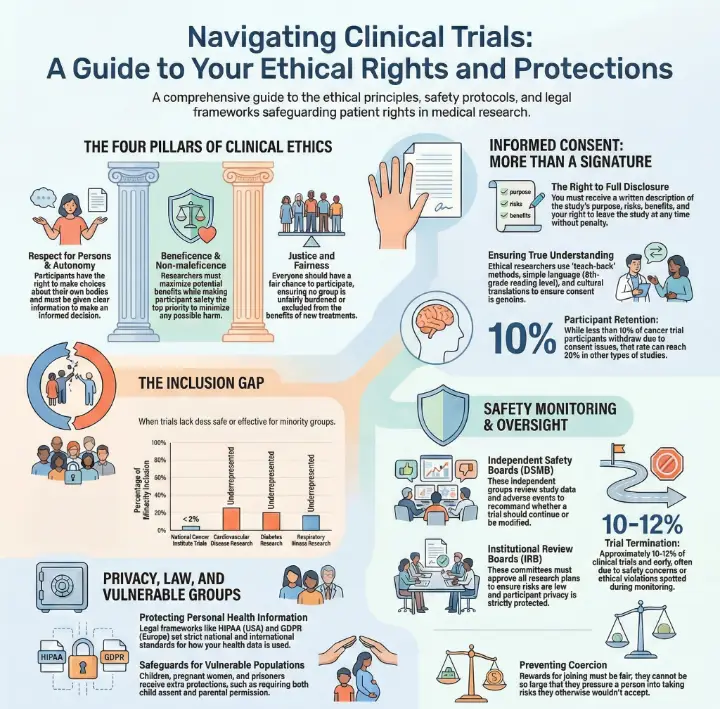
When you look at clinical trials, you find several key ethical issues:
Informed consent
Participant safety
Privacy and confidentiality
Fair subject selection
Transparency
The Ethics of Clinical Trials - Protecting Patient Rights means you must make sure every participant understands the risks, feels safe, and knows their information stays private. When trials ignore these values, you see public trust drop and important groups left out, which can lead to unreliable results and greater health gaps.
Key Takeaways
Informed consent is crucial. Always ask questions to understand the risks and benefits before joining a clinical trial.
Participant safety is a top priority. Researchers monitor health closely and take steps to minimize risks during trials.
Fair subject selection ensures everyone has a chance to participate. Inclusion of diverse groups leads to better and safer treatments for all.
Privacy and confidentiality are protected by strict laws. Your personal health information should always be kept secure.
Ethical guidelines help maintain trust in research. Understanding these principles empowers you to make informed decisions about participation.
The Ethics of Clinical Trials - Protecting Patient Rights
Core Ethical Principles
When you learn about The Ethics of Clinical Trials - Protecting Patient Rights, you see four main principles guide every decision. These principles help you understand why clinical trials must protect people who join. Here are the four core ethical principles:
Respect for persons
Beneficence
Non-maleficence
Justice
You also find other important values in clinical research guidelines:
Social and clinical value
Scientific validity
Fair subject selection
Favorable risk-benefit ratio
These principles make sure you get fair treatment and stay safe. Researchers use them to design studies that protect your rights and health. If you join a trial, these rules help you know what to expect and how your information stays private.
Respect for Persons and Autonomy
Respect for persons means you have the right to make choices about your own body and health. Autonomy lets you decide if you want to join a clinical trial. Researchers must give you clear information about the study, so you can make a smart choice. This process is called informed consent.
Tip: Always ask questions before you join a clinical trial. You should understand the risks and benefits.
Researchers also try to make trials easy for you to join. They work to reduce burdens like travel, time, and costs. You see respect for persons in every step, not just at the start. During the study, researchers keep checking on your needs and listen to your concerns. They also look at bigger problems, like if some groups have less access to healthcare or research. By fixing these issues, researchers show respect for everyone.
Informed consent helps you make your own decisions.
Researchers try to lower hardships, so you feel comfortable.
Study designs include your needs and make trials easier to join.
Ongoing respect means researchers keep you informed and safe.
Justice and Fairness
Justice means everyone should get a fair chance to join clinical trials. Fairness makes sure no group gets left out. If some people cannot join, they miss out on new treatments and better care. You see justice when researchers include people from different backgrounds, ages, and communities.
Study Focus | Percentage of Minority Inclusion |
|---|---|
National Cancer Institute Trials | < 2% |
Cardiovascular Disease Research | Underrepresented |
Diabetes Research | Underrepresented |
Respiratory Illness Research | Underrepresented |
When trials do not include enough people from minority groups, you get unclear results. This can make new medicines less safe or less helpful for some groups. It also increases health gaps between communities. If you belong to a group that is often left out, joining a trial can help build trust and improve care for everyone.
Excluded groups do not get high-quality trial care.
Participation helps build trust with groups that have faced unfair treatment.
Poor representation leads to unclear risks and benefits for some groups.
Missing data can make future drugs less effective for certain people.
Health gaps grow when some groups do not join trials.
The Ethics of Clinical Trials - Protecting Patient Rights means you get fair treatment, clear information, and respect for your choices. Researchers must follow these principles to keep you safe and make sure trials help everyone.
Informed Consent in Clinical Trials

What Is Informed Consent
Informed consent means you get all the facts before you join a clinical trial. You learn about the study’s purpose, what will happen, possible risks, and benefits. You also find out about your rights, like the choice to leave the study at any time. In many countries, you sign a written form after reading a clear description. An institutional review board (IRB) checks that the process protects you. In some places, like developing countries, the process may involve your community, especially if reading and writing are hard for some people.
You receive a written description of the study.
You sign the form to show you agree.
IRBs oversee the process to protect you.
In some regions, community leaders help with decisions.
Why It Matters
Informed consent helps you make smart choices about your health. You need to understand the risks and benefits before you join. If researchers rush or skip steps, you might not know enough to decide. Problems can happen if staff do not explain things well or use hard words. Sometimes, people feel pressure to sign quickly, or the forms are not clear. These mistakes can lead to confusion or even harm.
Note: If you do not understand something, ask questions until you feel sure.
Common problems include:
Staff with little clinical background getting your consent.
Poor timing, like asking you to sign when you feel stressed.
Consent forms that use words above an eighth-grade reading level.
Rushing through the process or missing details.
Ensuring True Consent
You deserve to understand every part of the study. Researchers use simple language and clear documents. They talk with you and answer your questions. Sometimes, they ask you to explain the study in your own words. This helps them know you really understand. If you speak another language or come from a different culture, they make sure the forms fit your needs. Vulnerable groups get extra help, sometimes from neutral third parties.
Researchers use teach-back methods to check your understanding.
They create easy-to-read documents.
They consider language and culture.
Extra care is given to vulnerable populations.
If you do not feel comfortable, you can leave the study. In cancer trials, less than 10% of people withdraw because of problems with consent. In other studies, withdrawal rates can reach up to 20%. The Ethics of Clinical Trials - Protecting Patient Rights means you get honest information and real choices. When you understand and agree, you help make research safe and fair for everyone.
Participant Safety and Risk-Benefit Balance
Ensuring Safety
You need to feel safe when you join a clinical trial. Researchers use strict rules to protect you. Many teams watch over your health and the study’s progress. These teams check for problems and make changes if needed. Here is a table showing who monitors your safety during a trial:
Protocol Type | Description |
|---|---|
Data and Safety Monitoring Board (DSMB) | Reviews research protocol, ongoing study activities, data quality, adverse events, and makes recommendations regarding trial continuation or modification. |
Study Monitoring Committee (SMC) | Oversees studies not monitored by a DSMB, ensuring independence and approval from NINDS. |
Independent Medical Monitor (IMM) | Appointed for studies with more than minimal risk, reviews protocol adherence and participant safety, and reports to NINDS. |
Principal Investigator (PI) | In minimal risk trials, the PI and IRB may monitor the study, focusing on participant safety and adverse events. |
Medical Safety Monitor (MSM) | Monitors serious adverse events in multi-center trials, ensuring good clinical practice and suggesting protocol modifications. |
These groups work together to keep you safe and respond quickly to any problems.
Minimizing Harm (Non-maleficence)
You deserve protection from harm during a clinical trial. Researchers must always put your safety first. They use special steps to lower risks and avoid problems. Here are some ways they do this:
Researchers work to reduce risks of adverse events.
They balance risks and benefits to keep you safe.
They take precautions to avoid harm.
Your safety stays the top priority throughout the study.
If you experience side effects, staff use clear guidelines to help you. For example, doctors use the Common Terminology Criteria for Adverse Events (CTCAE) to grade problems like rashes or infections. They choose treatments based on these grades, such as using topical antibiotics for mild conjunctivitis.
Assessing Risks and Benefits
You want to know if the benefits of a trial outweigh the risks. Researchers use different methods to measure this balance. They look at both good and bad outcomes. Here are some ways they check the risk-benefit ratio:
Confidence ellipse approach
Net Benefit Index (NBI)
Relative Benefit Index (RBI)
Success Rate Index (SRI)
Global benefit-risk (GBR) assessment
Multi-criteria decision analysis (MCDA)
Stochastic multi-criteria acceptability analysis (SMAA)
Researchers also watch for common problems like infusion reactions, rash, or infections. They track these events and adjust the study if needed. You help make trials safer by reporting any side effects you notice. When you join a trial, you become part of a team that works to protect everyone’s health.
Privacy, Confidentiality, and Vulnerable Populations

Protecting Privacy and Data
You trust researchers with your personal health information when you join a clinical trial. Protecting your privacy and keeping your data confidential is a top priority. Laws like HIPAA, the Common Rule, and FDA regulations set strict rules for how your information is used and shared.
Legal Framework | Description |
|---|---|
HIPAA | Sets national standards for protecting your health information and requires your permission. |
Common Rule | Makes sure research includes steps to protect your privacy and data. |
FDA Regulations | Requires review boards to check that your privacy stays safe in drug and device studies. |
You must give written permission before researchers use your health information. Sometimes, they remove your name and details to protect your identity. In multinational trials, rules can change from country to country. For example, the GDPR in Europe limits how data moves across borders. New technology and changing laws make it hard to keep up, so researchers must stay alert.
Tip: Ask how your data will be stored and who can see it before you join a study.
Special Protections for Vulnerable Groups
Some people need extra protection in clinical trials. Children, pregnant women, prisoners, and people who cannot make decisions for themselves are considered vulnerable. Laws require special rules for these groups. For example, children need both their own agreement and their parents’ permission. Pregnant women and prisoners have extra safeguards to keep them safe.
Children need both assent and parental permission.
Pregnant women and prisoners have special rules to protect them.
People with decision-making problems get extra help to understand the study.
These steps make sure you or your loved ones are not put at risk just because you belong to a vulnerable group.
Avoiding Coercion
You should never feel forced to join or stay in a clinical trial. In the past, some researchers used threats or promises to make people take part. Today, review boards check that you join by choice and understand what will happen. Coercion can be obvious, like threats, or subtle, like offering too much money or special treatment.
No one should threaten you with harm or loss if you say no.
You should not feel pressured by teachers, doctors, or anyone in power.
Payments or rewards must be fair and not so large that you feel you cannot refuse.
Review boards look closely at how researchers ask you to join. They make sure you understand your rights and can leave at any time. This protects your freedom and keeps research honest.
Oversight, Enforcement, and Consequences
Regulatory Guidelines and Ethics Committees
You can trust that strict rules guide every clinical trial. These rules come from both international and national organizations. Here is a table showing some of the main guidelines:
Regulatory Body | Guidelines | Description |
|---|---|---|
FDA | 21 CFR Part 50, 312, 812 | Regulations for informed consent and investigational products. |
EMA | Clinical Trials Directive (2001/20/EC), Clinical Trials Regulation (EU) No 536/2014 | Guidelines for clinical trials in the EU. |
ICH | Good Clinical Practice (GCP) | Ethical and scientific quality requirements for clinical trials. |
You also see important documents like:
The Nuremberg Code
The Belmont Report
The Declaration of Helsinki
Ethics committees, often called Institutional Review Boards (IRBs), protect your health and rights. They review study plans and make sure you stay safe. IRBs check that risks are low, benefits are fair, and your privacy is protected. They can approve, ask for changes, or stop a study if it does not meet standards.
According to FDA rules, IRBs can approve, require changes, or disapprove research to keep you safe.
Consequences of Unethical Conduct
If researchers break the rules, serious consequences follow. Here is what can happen:
Consequence | Description |
|---|---|
Inspectional Observations | Regulators inspect and note violations. |
Advisory or Enforcement Actions | Authorities may take action against the sponsor or investigator. |
Disqualification of Investigators | Investigators may lose the right to run future trials. |
Data Rejection | The FDA may reject the study data. |
Approval Delays | New treatments may face delays or rejection. |
Studies show that 10-12% of clinical trials end early. Safety or ethical problems often cause these stops. When rules are not followed, you may lose trust in research, and new treatments may not reach those who need them.
Ongoing Monitoring
You stay protected because trials use strong monitoring systems. These systems check that everyone follows the rules and keeps you safe. Monitoring includes:
Making sure you give true informed consent
Checking who joins the study
Watching for safety problems
Reviewing study documents
Using site visits and electronic tools
Researchers also create a data and safety monitoring plan (DSMP). This plan helps spot problems early and keeps the study honest.
Principal investigators must develop a DSMP to watch for changes in risk and keep data accurate during the trial.
Good monitoring systems help find and fix problems fast. They protect your rights, keep data honest, and build trust in medical research.
You play a key role in The Ethics of Clinical Trials - Protecting Patient Rights. When you understand ethical standards, you help protect participants and support research credibility. Ethical guidelines keep you safe, prevent unfair treatment, and ensure research has value. History shows that ignoring these rules can harm people and damage trust. Staying informed and aware helps you build trust in medical research and encourages responsible participation.
Ethical standards protect your safety and rights.
Ongoing vigilance keeps research honest and trustworthy.
Your awareness supports better health for everyone.
FAQ
What is the main goal of ethics in clinical trials?
You see ethics in clinical trials to protect your rights and safety. Ethics help you get fair treatment and honest information. They also make sure research results stay trustworthy.
Can you leave a clinical trial after joining?
Yes, you can leave a clinical trial at any time. You do not need to give a reason. Your decision will not affect your regular medical care.
How do researchers keep your information private?
Researchers use secure systems to store your data. They remove your name and details when possible. Only approved staff can see your information.
Why do some groups need extra protection in trials?
Some people, like children or those with health problems, may not understand all risks. Extra rules help keep you safe and make sure you join by choice.
This article is for educational purposes only and is not a substitute for professional medical advice. For more details, please see our Disclaimer. To understand how we create and review our content, please see our Editorial Policy.
See Also
Key Characteristics of Glioblastoma You Should Know
Symptoms and Treatment Options for Choroid Plexus Carcinoma
An Overview of Malignant Peripheral Nerve Sheath Tumors

© 2026 Banish Cancer. Banish Cancer is a registered non-profit organization providing evidence-based research, educational courses, and Fear Response AI support services. Reg. No: 305706884 | Address: Taikos pr. 43-603, Kaunas, Lithuania.