Understanding Cancer Staging Numbers and Letters Made Simple

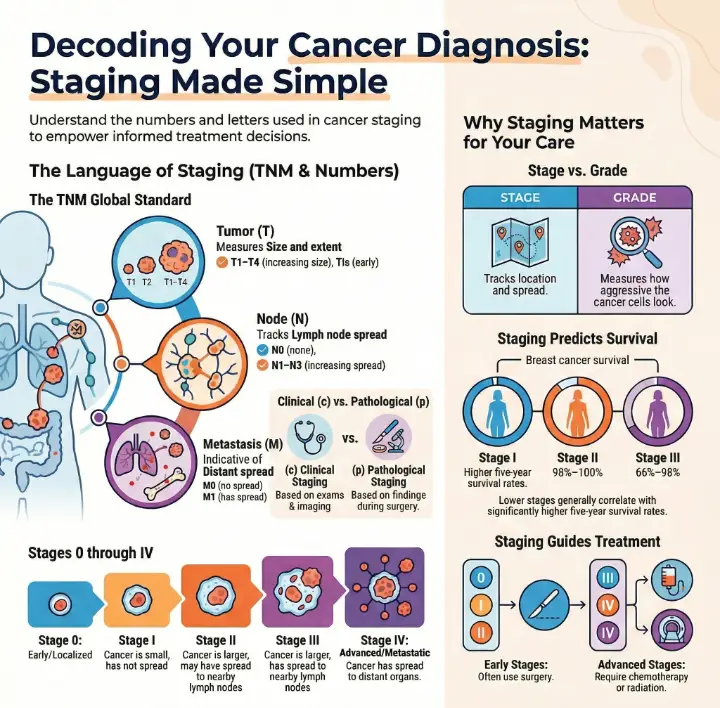
You may feel overwhelmed when you hear numbers and letters in your cancer diagnosis. These symbols show how much cancer has grown or spread in your body. When you understand what they mean, you can talk with your doctor and make better choices. You do not need to feel lost. Understanding Cancer Staging: What Do All These Numbers Mean will help you feel more confident and informed.
Key Takeaways
Understanding cancer staging helps you know how much cancer is in your body and where it has spread.
Knowing your cancer stage empowers you to make informed decisions about your treatment options.
Doctors use staging to predict survival rates, so early detection can significantly improve your chances.
Ask your doctor to explain your cancer stage and treatment options to feel more confident in your care.
Stay involved in your follow-up care to monitor your health and manage any side effects.
Understanding Cancer Staging: What Do All These Numbers Mean

When you first hear about cancer staging, you might wonder what all the numbers and letters mean. These symbols are not random. They give you and your doctors a clear picture of how much cancer is in your body and where it has spread. Understanding Cancer Staging: What Do All These Numbers Mean can help you see why these details matter for your care.
Why Cancer Staging Matters
Cancer staging uses numbers and letters to describe the size of the tumor, if it has spread to nearby lymph nodes, and if it has reached other parts of your body. This information helps you and your doctor know how serious the cancer is. For example, a lower stage usually means the cancer is smaller and has not spread. A higher stage means the cancer has grown or moved to other areas.
Knowing your cancer stage gives you power. It helps you understand your diagnosis and what to expect.
Doctors use staging to predict how the cancer might behave. Studies show that the stage at diagnosis is the strongest predictor of survival for many cancers. For example, in colorectal cancer, patients with stage IIIb have a 64% chance of living five years, while those with stage IIIc have only a 37% chance. In breast cancer, the difference is also clear:
Breast Cancer Stage | 5-Year Breast Cancer-Specific Survival Rate |
|---|---|
I (1) | 98%-100% |
II (2) | 90%-99% |
III (3) | 66%-98% |
You can see that people with lower stages have a much better chance of survival. Understanding Cancer Staging: What Do All These Numbers Mean can help you see why catching cancer early makes a big difference.
Staging also helps doctors compare results and improve treatments. Accurate staging lets them track how well treatments work for different groups of patients. This information helps researchers and doctors find better ways to treat cancer in the future.
Here are some key points about why staging matters:
Staging shows how much cancer is in your body.
It helps predict your chances of recovery.
It helps researchers study cancer and improve care.
How Staging Guides Treatment Decisions
When you know your cancer stage, you and your doctor can make better choices about your treatment. Understanding Cancer Staging: What Do All These Numbers Mean is important because it affects every step of your care plan.
Doctors use staging to decide which treatments will work best. For example, if your cancer is at an early stage, surgery might remove all of it. If the cancer has spread, you might need chemotherapy or radiation. Staging also helps doctors find clinical trials that could offer new treatments for your stage of cancer.
Here is how staging guides treatment:
It helps doctors see how serious the cancer is and what your chances are.
It lets them plan the most effective treatment for you.
It helps them find clinical trials that match your stage.
You can also look at guidelines from trusted sources. For example:
Source | Description |
|---|---|
NCCN Guidelines | Recommendations for treatment based on cancer type and stage. |
Cancer Care Ontario | Person-Centred Virtual Cancer Care Clinical Guidance for various cancer types. |
Doctors follow these guidelines to make sure you get the best care for your stage of cancer.
Tip: Ask your doctor to explain your stage and what it means for your treatment. The more you know, the more confident you will feel about your choices.
Understanding Cancer Staging: What Do All These Numbers Mean gives you the tools to talk with your healthcare team, understand your options, and take an active role in your care.
Cancer Staging Systems
When you learn about cancer, you will see different systems that doctors use to describe how far the disease has spread. The most common system is the TNM system. Understanding Cancer Staging: What Do All These Numbers Mean can help you make sense of these letters and numbers.
TNM System: T, N, and M Explained
The TNM system is the global standard for cancer assessment. Doctors and cancer registries around the world use it. TNM stands for Tumor, Node, and Metastasis. Each part gives you important information about your cancer.
Component | What the Letters and Numbers Mean | |
|---|---|---|
Tumor (T) | Size and extent of the main tumor | TX: Cannot be evaluated, T0: No tumor, Tis: Early cancer, T1-T4: Tumor size and spread |
Node (N) | Lymph node involvement | NX: Cannot be assessed, N0: No spread, N1-N3: More lymph nodes involved |
Metastasis (M) | Spread to distant body parts | MX: Cannot be evaluated, M0: No spread, M1: Cancer has spread |
You may see numbers after each letter. For example, T2 means the tumor is larger than T1 but smaller than T3. N1 means some lymph nodes have cancer, while N0 means none do. M1 means cancer has spread to other organs.
Number Staging: Stages 0 to IV
Doctors also use number staging, which goes from 0 to IV. These stages use Roman numerals. Each stage tells you how much cancer is in your body.
Stage | |
|---|---|
0 | Cancer is only in one place and has not spread. |
I | Cancer is small and has not spread much. |
II | Cancer is larger or has spread to nearby areas. |
III | Cancer has spread more, often to lymph nodes. |
IV | Cancer has spread to distant parts of the body. |
Understanding Cancer Staging: What Do All These Numbers Mean helps you see why these stages matter. Stage 0 means the cancer is very early. Stage IV means the cancer has spread far from where it started.
Letter Subdivisions and Special Cases
Sometimes, you will see letters like A, B, or C after the stage number. These letters give more details about the cancer. For example, stage IIA means the cancer is a bit more advanced than stage IA. This helps doctors describe your cancer more exactly.
You may also see special codes like NX, TX, or c and p. NX means doctors cannot check the lymph nodes. TX means they cannot assess the main tumor. The letter "c" means the stage is based on clinical exams. The letter "p" means the stage is based on what doctors find during surgery.
Tip: Ask your doctor to explain any letters or numbers you see in your diagnosis. This will help you understand your cancer and your treatment options.
Understanding Cancer Staging: What Do All These Numbers Mean gives you the tools to talk with your care team and make informed choices.
Stage vs. Grade
What Is Stage?
You may hear your doctor talk about the stage of your cancer. Stage tells you how much cancer is in your body and where it has spread. Doctors use numbers from I to IV. Stage I means the cancer is small and only in one place. Stage IV means the cancer has spread to other parts of your body. To find your stage, doctors look at the size of the tumor, if it has invaded nearby organs, if it has reached lymph nodes, and if it has moved to distant locations. The TNM system helps doctors decide your stage:
Tumor size (T)
Spread to lymph nodes (N)
Metastasis to other areas (M)
Stage helps your doctor plan your treatment and predict how the cancer might behave.
What Is Grade?
Grade is different from stage. Grade shows how abnormal the cancer cells look under a microscope. A pathologist checks tissue samples from a biopsy. If the cells look more like normal cells, the tumor is less aggressive. If the cells look very different, the tumor is more aggressive and may grow faster.
Doctors use grade to see how quickly the cancer might grow.
Grade helps show how likely the cancer is to spread.
Aspect | Cancer Grade | Cancer Stage |
|---|---|---|
How abnormal the cancer cells appear under a microscope. | Size of the tumor and whether it has spread. | |
Clinical Significance | Suggests how aggressive the tumor is and its growth rate. | Important for determining the extent of disease and treatment planning. |
Why Both Are Important
You need to know both the stage and grade of your cancer. Stage helps your doctor choose the right treatment and make a prognosis. Grade shows how fast the cancer might grow or spread. Your treatment plan depends on both. Clinical staging is a major factor in predicting outcomes, but grade also gives clues about how the tumor will behave. Doctors use both to compare treatment results and find the best strategies for your care.
Knowing your stage and grade helps you understand your diagnosis and take an active role in your treatment decisions.
How Staging Is Determined
Tests and Procedures
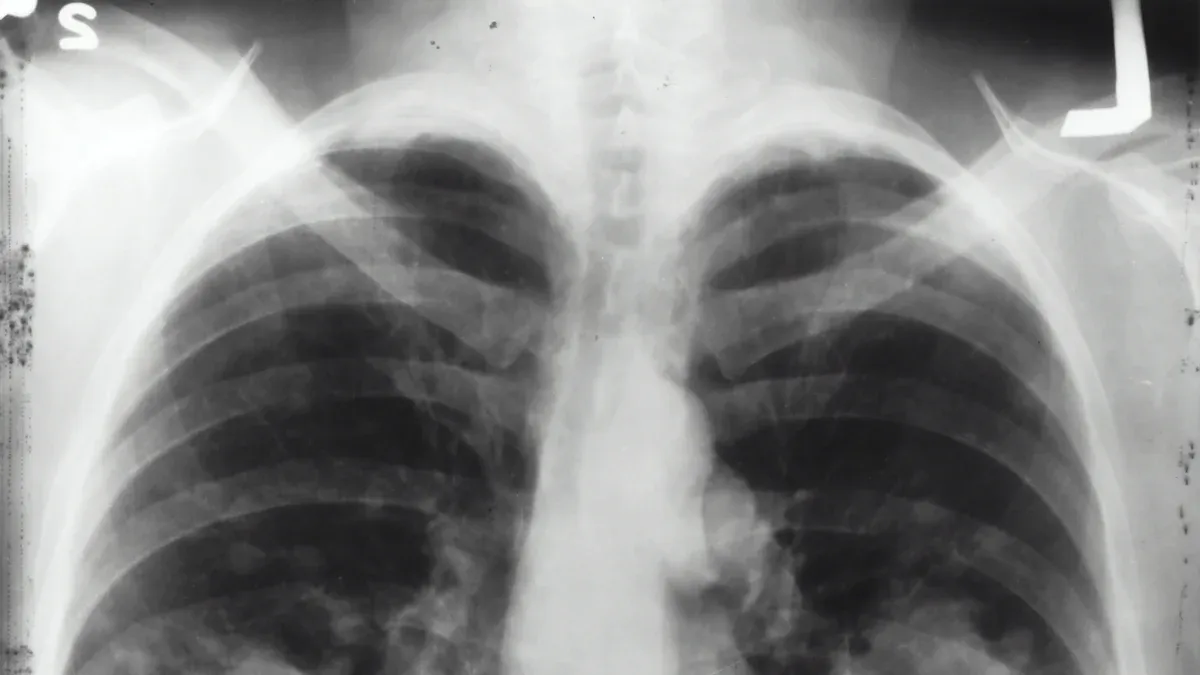
Doctors use several tests and procedures to find out your cancer stage. These tests help them see where the cancer is, how big it is, and if it has spread. You may need one or more of these tests:
Imaging tests: These include X-rays, CT scans, MRI, bone scans, and PET scans. Imaging helps doctors see tumors inside your body.
Lab tests: Blood and urine tests can show signs of cancer or how your organs are working.
Biopsies: Doctors take a small piece of tissue to look at under a microscope. This helps them see what kind of cancer you have.
Special procedures: For some cancers, you might need a laparotomy (for colon cancer) or a sentinel lymph node biopsy (for breast cancer).
Recent advances in image-guided biopsies make it easier for doctors to get tissue samples from many parts of your body with little risk. These techniques work well for most cancers. For example, image-guided biopsies in melanoma have high accuracy, with 92% sensitivity and 96% specificity. The size and location of the tumor can affect how well these tests work. Larger tumors are easier to detect than very small ones.
Note: Your doctor will choose the tests that fit your situation best. Each test gives important clues about your cancer.
Factors Doctors Consider
Doctors look at several key factors when they decide your cancer stage. They use this information to plan your treatment and predict how the cancer might behave.
Factor Type | Description |
|---|---|
Tumor Size | How big the tumor is. This is a main part of the TNM system. |
Lymph Node Involvement | Whether cancer has spread to nearby lymph nodes. |
Metastasis | If the cancer has moved to other parts of your body. |
Tumor Grade | How abnormal the cancer cells look. This can affect your treatment and outlook. |
A team of specialists often works together to decide your stage. These teams include doctors, pathologists, and imaging experts. They meet to discuss your case, review test results, and make sure you get the most accurate stage. When teams work together, you are more likely to get the right diagnosis and start treatment sooner.
Evidence Type | Description |
|---|---|
MDM Meetings | Teams of doctors, pathologists, and imaging experts meet to review and record your cancer stage. |
Collective Staging | Team discussions help choose the best tests and improve staging accuracy. |
Patient-Centered Care | Working together helps you get fast, coordinated, and effective care. |
Tip: You can ask your doctor who is on your care team and how they work together to decide your stage.
Staging and Treatment Options
Treatment Choices by Stage
You will see that your cancer stage shapes your treatment plan. Doctors use your stage to decide which therapies will help you most. Early-stage cancers often respond well to surgery and standard treatments. Advanced stages need more complex approaches.
Stage | |
|---|---|
Stage I | Surgery (Whipple procedure), adjuvant treatment (chemotherapy/radiation), clinical trials |
Stage II | Surgery (resectable/borderline resectable), neoadjuvant therapy (chemotherapy/radiation), clinical trials |
Stage III | Chemotherapy, radiation, clinical trials |
Stage IV | Chemotherapy, clinical trials |
You may notice that surgery is common in early stages. Chemotherapy and radiation become more important as cancer spreads. Doctors sometimes use new therapies, like immunotherapy or hormone therapy, for advanced cancers.
Treatment Modality | Description | Stage of Cancer |
|---|---|---|
Conventional | Surgery, chemotherapy, radiotherapy | Early to advanced stages |
Advanced/Novel | Hormone therapy, immunotherapy, stem cell therapy | Primarily for advanced stages |
Importance of Timing | Early detection crucial for survival | Delays can shift intent from curative to palliative |
Doctors focus on curing cancer in early stages. In advanced stages, they may shift to managing symptoms and improving your quality of life.
Prognosis and Next Steps
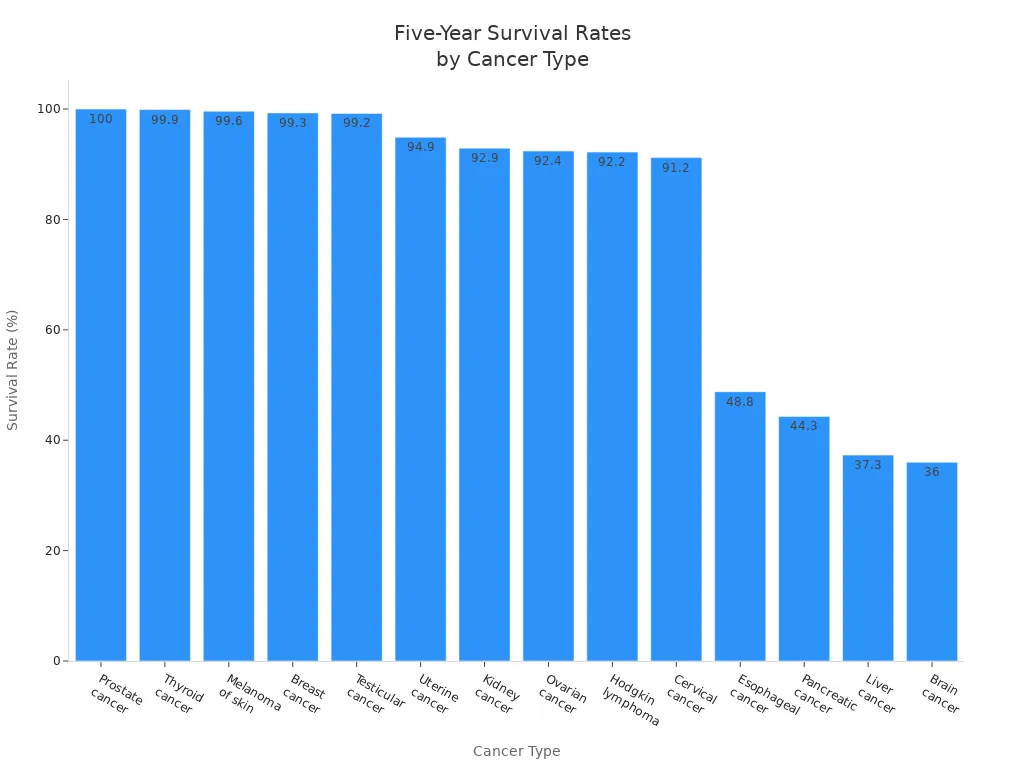
Your prognosis depends on your cancer stage and type. Early detection gives you the best chance for recovery. Survival rates vary by cancer type. For example, prostate cancer has a five-year survival rate of 100%. Liver cancer has a rate of 37.3%. You can see these differences in the table below.
Cancer Type | Five-Year Survival Rate |
|---|---|
Prostate cancer | 100% |
Thyroid cancer | 99.9% |
Melanoma of skin | 99.6% |
Breast cancer | 99.3% |
Liver cancer | 37.3% |
Brain cancer | 36% |
After your initial treatment plan, you should follow up with your healthcare team. Regular check-ups and tests help monitor for recurrence and manage side effects. Your doctor will create a personalized follow-up plan. This plan may include physical exams, blood tests, and imaging scans. Keep records of your treatment and care plan. Staying involved in your follow-up care helps you stay healthy and informed.
Tip: Ask your doctor about your follow-up schedule and what tests you need. Staying proactive supports your recovery and peace of mind.
You now know what cancer staging numbers and letters mean. This knowledge helps you feel informed and supported. When you understand your stage, you can:
Take part in treatment decisions
Align choices with your values
Work closely with your healthcare team
Good communication leads to better care and outcomes. If you want more support, you can find help at Cancer Staging, the 24/7 Cancer Helpline, or Programs & Services. Never hesitate to ask your care team questions.
FAQ
What does "stage" mean in cancer?
Stage shows how much cancer is in your body and where it has spread. Doctors use numbers and letters to describe this. You can use this information to understand your diagnosis and treatment plan.
Why do doctors use letters like "A" or "B" after the stage?
Doctors add letters to give more details about your cancer. For example, stage IIIB means the cancer is more advanced than stage IIIA. You can ask your doctor what these letters mean for your care.
Can my cancer stage change after treatment?
Yes, your stage can change if cancer grows or shrinks. Doctors may restage your cancer after new tests. You should ask your care team about any changes and what they mean for your treatment.
What is the difference between stage and grade?
Stage | Grade |
|---|---|
Shows how much cancer is in your body | Shows how abnormal the cancer cells look |
Helps plan treatment | Helps predict how fast cancer may grow |
How can I learn more about my cancer stage?
Tip: Ask your doctor to explain your stage in simple words. You can also visit trusted websites like the American Cancer Society for more information.
This article is for educational purposes only and is not a substitute for professional medical advice. For more details, please see our Disclaimer. To understand how we create and review our content, please see our Editorial Policy.
See Also
Simplifying B-Cell Prolymphocytic Leukemia for Better Insight
Decoding Large-Cell Lung Carcinoma and Its Types
An In-Depth Overview of Various Cancer Categories

© 2026 Banish Cancer. Banish Cancer is a registered non-profit organization providing evidence-based research, educational courses, and Fear Response AI support services. Reg. No: 305706884 | Address: Taikos pr. 43-603, Kaunas, Lithuania.