Understanding Genetics and Cancer Risk

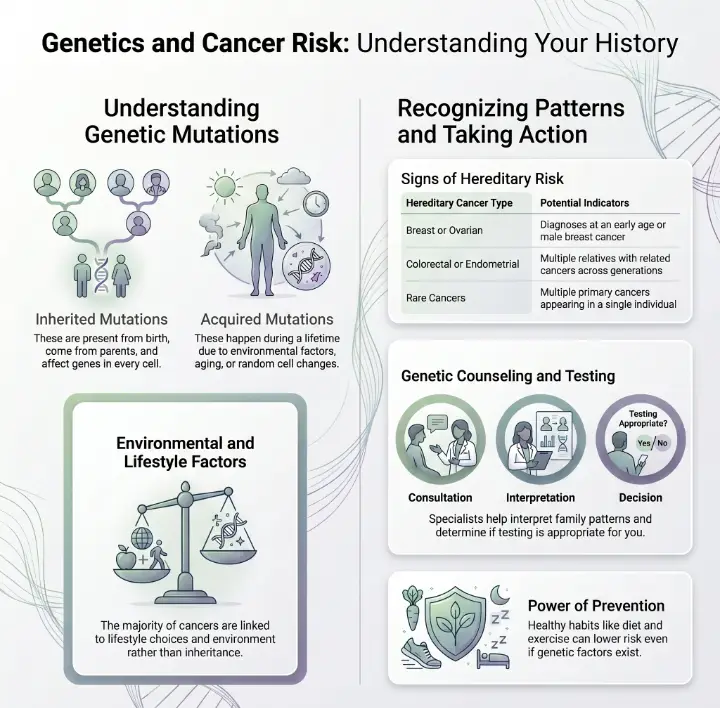
Genetics can play a big part in your risk for cancer. Some people inherit changes in their genes that make cancer more likely. Most cancers do not come from inherited mutations, but about 5% to 15% of cases do. You may wonder if your family history puts you at higher risk. Here are some signs that genetics might play a role:
A cancer diagnosis before age 50 in you or a close relative
More than one type of cancer in the same person
The same or related cancers appearing in several family members across generations
Certain backgrounds, like Ashkenazi Jewish ancestry, that carry common genetic mutations
Knowing your family history and your genetic makeup helps you make informed choices. Understanding the Role of Genetics in Cancer Prevention can guide you to better health decisions.
Key Takeaways
Genetics can increase cancer risk, but most cancers are not inherited.
Inherited mutations are present from birth, while acquired mutations happen over time.
Family history can indicate higher cancer risk; consider genetic counseling if needed.
Lifestyle choices like diet and exercise can lower cancer risk, even with genetic factors.
Genetic testing helps understand cancer risk, but it has benefits and limitations.
Genetics and Cancer Risk
Inherited vs. Acquired Mutations
You may wonder why some people develop cancer even without a family history. The answer lies in the difference between inherited and acquired mutations. Inherited mutations are present from birth. These mutations come from your parents and affect the genes in every cell of your body. They often follow an autosomal dominant pattern, which means you only need one copy of the mutated gene to increase your risk. These mutations usually involve high-penetrance genes, making cancer more likely.
Acquired mutations happen during your lifetime. Environmental factors, aging, or random changes in your cells cause these mutations. They affect only certain cells and do not pass to your children. Most cancers result from acquired mutations, not inherited ones.
Tip: Knowing whether a mutation is inherited or acquired helps you understand your risk and guides your choices for prevention.
How Mutations Affect Cancer Development
Mutations change the way your cells work. Every cancer starts with damage to genes inside cells. When a cell with a mutation divides, it passes the damaged genes to new cells. Over time, these changes build up. They can disrupt normal cell functions and cause cells to grow out of control. This uncontrolled growth leads to cancer.
Some genes play a bigger role in cancer risk. Here is a table showing common genes linked to cancer:
Gene | Associated Cancer Types |
|---|---|
BRCA1 | Breast and ovarian cancer |
BRCA2 | Breast, ovarian, pancreatic cancer |
MLH1 | Colorectal cancer (Lynch syndrome) |
MSH2 | Colorectal cancer (Lynch syndrome) |
MSH6 | Colorectal cancer (Lynch syndrome) |
PMS2 | Colorectal cancer (Lynch syndrome) |
TP53 | Li-Fraumeni syndrome (breast, leukemia) |
CDH1 | Hereditary diffuse gastric cancer |
PTEN | Cowden syndrome (breast cancer) |
STK11 | Peutz-Jeghers syndrome (various cancers) |
CHEK2 | Breast cancer |
ATM | Prostate, breast cancer |
PALB2 | Breast and ovarian cancer |
RAD51C | Breast and ovarian cancer |
RAD51D | Breast and ovarian cancer |
HOXB13 | Prostate cancer |
You may have heard about BRCA1 and BRCA2. These genes are famous for their link to breast and ovarian cancer. Other genes, like MLH1 and MSH2, increase the risk for colorectal cancer. If you have a mutation in one of these genes, your risk goes up.
Most cancers do not come from inherited mutations. Only 5-10% of cancers are due to inherited genetic defects. About 90-95% of cancers happen because of environmental factors. The rates of certain cancers differ across countries, showing that lifestyle and environment matter. Studies of identical twins also show that habits and choices play a big role in cancer development.
Only a small percentage of cancers are inherited.
Most cancers are linked to environmental factors.
Cancer rates change based on where you live and how you live.
Lifestyle choices, such as diet and exercise, affect your risk.
Family History and Risk
Your family history can give clues about your cancer risk. If you have close relatives with cancer, your risk may be higher. The risk depends on several factors:
The closeness of your relationship to affected relatives. Parents, siblings, and children matter most.
The number of relatives diagnosed. More affected relatives increase your risk.
The age at which relatives were diagnosed. Younger age means higher risk.
The type of cancer. Some types, like triple-negative breast cancer, signal higher risk.
The presence of known genetic mutations, such as BRCA1 or BRCA2.
You should pay attention if you notice these signs in your family:
Multiple cancers in close relatives, especially across generations.
Cancer diagnosed before age 50.
Two or more different cancers in one person.
Bilateral cancers (cancer in both organs, like both breasts).
Rare cancers, such as male breast cancer.
Known cancer risk mutations in your family.
Note: If you see these patterns, you may benefit from genetic counseling. A specialist can help you understand your risk and decide if genetic testing is right for you.
Cancer risk increases with a strong family history. If you have several relatives with cancer, especially at a young age, your risk goes up. You can use this information to make smart choices about screening and prevention.
Hereditary Cancer Types and Signs
Common Hereditary Cancers
You may wonder which cancers are most often linked to inherited gene mutations. Hereditary cancers develop when you inherit a genetic change from your parents. About 5% to 10% of all cancers come from inherited mutations. Some cancers have stronger links to family history and genetics. Here are some common hereditary cancers:
Breast cancer (especially with BRCA1 or BRCA2 mutations)
Ovarian cancer
Prostate cancer
Pancreatic cancer
Colorectal cancer (often linked to Lynch syndrome)
Endometrial cancer
Mutations in BRCA1 and BRCA2 genes raise your lifetime risk for breast cancer to 60%–85%. These mutations also increase your risk for ovarian cancer to 16%–44%. Lynch syndrome causes higher risks for colorectal and endometrial cancers.
Recognizing Genetic Risk Factors
You can spot signs of hereditary cancer risk by looking at your family history and personal health. Certain patterns suggest a higher chance of inherited mutations:
Rare cancers, such as ovarian cancer or male breast cancer
Several close relatives with the same or related cancers
Ancestry with higher mutation rates, like Ashkenazi Jewish background
Known pathogenic variants in your family
Some syndromes, like hereditary breast and ovarian cancer syndrome (HBOC) and Lynch syndrome, show clear genetic risk factors. You should pay attention if you see unusual presentations, such as cancer in both breasts or several types of cancer in one person.
Tip: Keep a record of your family’s cancer history. Patterns can help you and your doctor decide if genetic testing is right for you.
When to Seek Medical Advice
You should talk to a healthcare provider if you notice these signs in your family:
Multiple cancers in close relatives across generations
Early onset of cancer (before age 40 or 50)
Multiple primary cancers in one individual
Bilateral cancers (both organs affected)
Related cancers in the family, like breast and ovarian cancer
Congenital anomalies linked to cancer risk
Abnormal tumor test results suggestive of hereditary syndromes
Doctors can help you understand your risk and guide you toward genetic counseling or testing. Early advice can lead to better prevention and care.
Understanding the Role of Genetics in Cancer Prevention
Lifestyle and Prevention
You can take steps to lower your cancer risk, even if you have a family history or a known genetic mutation. Understanding the Role of Genetics in Cancer Prevention helps you see that your choices matter. Most cancers do not come from inherited genes. In fact, 90-95% of cancer cases link to environmental and lifestyle factors, not genetics. This means you have power to change your risk.
Healthy habits make a big difference. Here is a table that shows how your choices affect cancer risk:
Factor | Impact on Cancer Risk |
|---|---|
Smoking | Causes 25-30% of cancer-related deaths |
Diet | Linked to 30-35% of cancer cases |
Exercise | Lowers colon cancer risk by 40-50% and breast cancer by 30-40% |
Weight Loss (Women) | Losing weight after menopause lowers breast cancer risk by 23% |
Weight Loss (Men) | Losing 11+ pounds over ten years lowers prostate cancer risk by 16-17% |
You can:
Stop smoking to lower your risk for many cancers.
Eat more fruits, vegetables, and whole grains.
Stay active with regular exercise.
Keep a healthy weight.
Tip: Even if you have a genetic mutation, these steps can help you stay healthier and may lower your risk.
Understanding the Role of Genetics in Cancer Prevention means you do not have to feel powerless. Your actions matter, and you can make choices that protect your health.
Screening and Early Detection
Screening helps find cancer early, when it is easier to treat. If you have a higher genetic risk, you may need to start screening at a younger age or do it more often. Understanding the Role of Genetics in Cancer Prevention means working with your doctor to make a plan that fits your risk.
Doctors use your family history, genetic test results, and other factors to decide when and how often you need screening. For example, you may need mammograms or breast MRIs every year if you have a BRCA mutation. You may need colonoscopies more often if you have Lynch syndrome.
Note: Screening does not prevent cancer, but it can catch it early. Early detection saves lives.
You should talk with your healthcare provider about:
When to start screening for cancers like breast, colon, or prostate cancer.
Which tests are right for you based on your genetic risk.
How often you need these tests.
Understanding the Role of Genetics in Cancer Prevention helps you and your doctor create a screening plan that gives you the best chance for early detection.
Medical Risk Reduction
Some people with high-risk genetic mutations may need more than lifestyle changes and screening. Medical options can lower your risk even more. Understanding the Role of Genetics in Cancer Prevention includes learning about these choices.
Here are some medical interventions that can help:
Intervention Type | Description |
|---|---|
Tamoxifen and raloxifene can lower breast cancer risk in women with high risk. | |
Surgery | Preventive surgery can remove tissue before cancer starts, such as breasts or ovaries for BRCA mutations. |
Yearly screening | More frequent tests like breast MRI and mammograms for those at high risk. |
Healthy behaviors | Staying active and keeping a healthy weight also help lower risk. |
You may consider:
Taking medications like tamoxifen or raloxifene if your doctor recommends them.
Having preventive surgery to remove high-risk tissue before cancer can develop.
Scheduling yearly screenings with MRI and mammograms.
Keeping up with healthy habits every day.
Alert: Inheriting a mutation does not mean you will get cancer. Most people with a genetic risk do not develop cancer. Most cancers are not inherited.
Understanding the Role of Genetics in Cancer Prevention gives you tools to take charge of your health. You can work with your healthcare team to choose the best steps for you. These steps may include lifestyle changes, regular screening, and medical treatments. You have options, and you can make choices that fit your needs.
Genetic Testing and Interpretation
Who Should Get Tested
You may wonder if you should consider genetic testing for cancer risk. Doctors recommend testing for people with certain personal or family histories. If you or a close relative meet any of these criteria, you may benefit from testing:
Age Criteria | |
|---|---|
Breast cancer | Diagnosed at or before age 50 |
Ovarian cancer | Any age or stage |
Triple negative breast cancer (TNBC) | Diagnosed at age 60 or younger |
Male breast cancer | Any age or stage |
Pancreatic cancer | Any age or stage |
Metastatic prostate cancer | Any age |
Metastatic breast cancer with PARP inhibitor | Any age |
You should also think about testing if you have:
Early-onset cancers (before age 50)
Multiple primary cancers in one person
Rare cancers, like ovarian cancer
Family history of related cancers across generations
Ashkenazi Jewish ancestry
A known harmful gene variant in your family
Benefits and Limitations
Genetic testing can help you take control of your health. Here are some benefits:
Benefit | Description |
|---|---|
You can start screenings sooner and have them more often. | |
Lifestyle changes | You may choose healthier habits, like eating better and exercising. |
Medications | Doctors may suggest medicines to lower your risk. |
Prophylactic surgery | You might consider surgery to remove tissue before cancer starts. |
Informing family members | Your results can help relatives decide if they need testing. |
Testing also has some drawbacks:
Learning about a higher risk can cause stress.
You may feel guilty if you do not have a harmful gene but others do.
Some results are unclear and may not give answers.
Testing and follow-up care can be expensive.
Privacy and insurance concerns may arise.
Results can sometimes be misleading or hard to understand.
Making Sense of Results
You may feel confused when you get your test results. Here is what the results can mean:
Result Type | Explanation |
|---|---|
Positive result | You have a gene change that raises your cancer risk. Your doctor can help you plan next steps. |
Negative result | No harmful gene changes found. Your risk is like most people, but not zero. |
Variant of uncertain significance | The test found a gene change, but experts do not know if it raises your risk. This may change as science learns more. |
Tip: Genetic counselors can help you understand your results and decide what to do next. Many clinics and national groups offer support and information.
Understanding your genetic risk for cancer helps you make smart health choices. Only 5% to 10% of cancers are hereditary, but knowing your family history and talking with a healthcare provider can guide your next steps. You can:
Meet with a genetic counselor to discuss your family’s health.
Consider genetic testing if you have a strong family history.
Learn about ways to lower your risk.
Here are some trusted resources for more information:
Resource | Description |
|---|---|
Cancer & Genetics | Learn about genetic counseling and testing. |
Find details on testing and labs. |
You have the power to take action for your health.
FAQ
What does it mean if you have a genetic mutation linked to cancer?
You have a higher chance of getting certain cancers. This does not mean you will get cancer for sure. You can lower your risk with healthy habits, regular checkups, and talking with your doctor.
Can you prevent cancer if it runs in your family?
You cannot change your genes, but you can lower your risk. Try these steps:
Eat healthy foods.
Stay active.
Avoid smoking.
Get regular screenings.
Should you get genetic testing if no one in your family has cancer?
Most people do not need testing if their family has no cancer history. You should talk with your doctor if you have concerns or belong to a group with higher risk.
Will insurance cover genetic testing for cancer risk?
Insurance Type | Coverage for Testing |
|---|---|
Private | Often covers if you meet guidelines |
Medicare | Covers in some cases |
Medicaid | Varies by state |
Check with your insurance company before testing.
This article is for educational purposes only and is not a substitute for professional medical advice. For more details, please see our Disclaimer. To understand how we create and review our content, please see our Editorial Policy.
See Also
An In-Depth Overview of Various Cancer Types
Key Characteristics of Glioblastoma: A Detailed Overview
Essential Information About Carcinoid Tumors You Need

© 2026 Banish Cancer. Banish Cancer is a registered non-profit organization providing evidence-based research, educational courses, and Fear Response AI support services. Reg. No: 305706884 | Address: Taikos pr. 43-603, Kaunas, Lithuania.