Gamma Knife or CyberKnife Which Is Better for Brain Tumors

Gamma Knife delivers sub‑millimeter precision, typically ≤0.5 mm.
You may wonder which option works best for brain tumors. The answer depends on your tumor and your health needs. Both treatments offer precise outpatient radiosurgery. You will notice differences in technology, patient comfort, and flexibility. Focus on the treatment process, safety, and suitability for your situation. Always talk with your medical team before making a decision.
Key Takeaways
Gamma Knife uses focused gamma rays for precise treatment of brain tumors, while CyberKnife employs a robotic arm for flexibility and real-time tracking.
Patient comfort varies: Gamma Knife traditionally requires a rigid head frame (some newer models offer a mask option), which can be uncomfortable, whereas CyberKnife uses a soft mask for a more pleasant experience.
Both Gamma Knife and CyberKnife can offer high local control and fewer immediate risks than open surgery for many small, clearly defined brain tumors, but results still depend on the tumor’s type, size, number, and location.
CyberKnife offers greater anatomical versatility because it can treat both brain and body tumors, while Gamma Knife is purpose‑built for the brain and excels at small, deep, or centrally located intracranial targets.
Always consult with your medical team to determine which treatment option best suits your tumor type, location, and personal comfort needs.
Gamma Knife vs. Cyber Knife: Which One’s for Your Brain Tumor?
Both offer advanced radiosurgery for brain tumors, but the technology, flexibility, and comfort can affect your experience.
Technology Differences
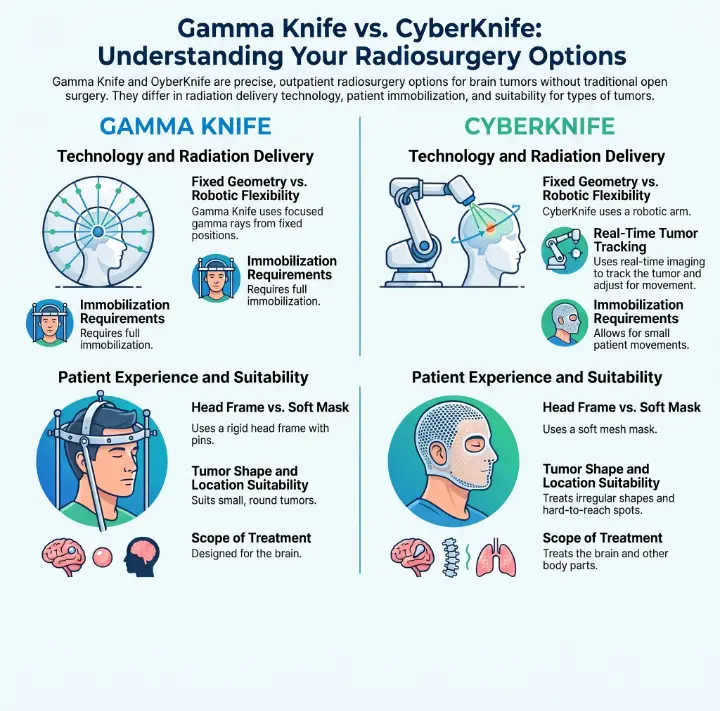
Gamma Knife uses focused gamma rays to target brain tumors. It is designed just for the brain. The system sends multiple beams from a fixed position, all meeting at the tumor. This method gives high precision for brain treatment.
Newer Gamma Knife models, such as the Leksell Gamma Knife Icon, also support frameless mask-based immobilization and fractionated treatment over 2–5 sessions.
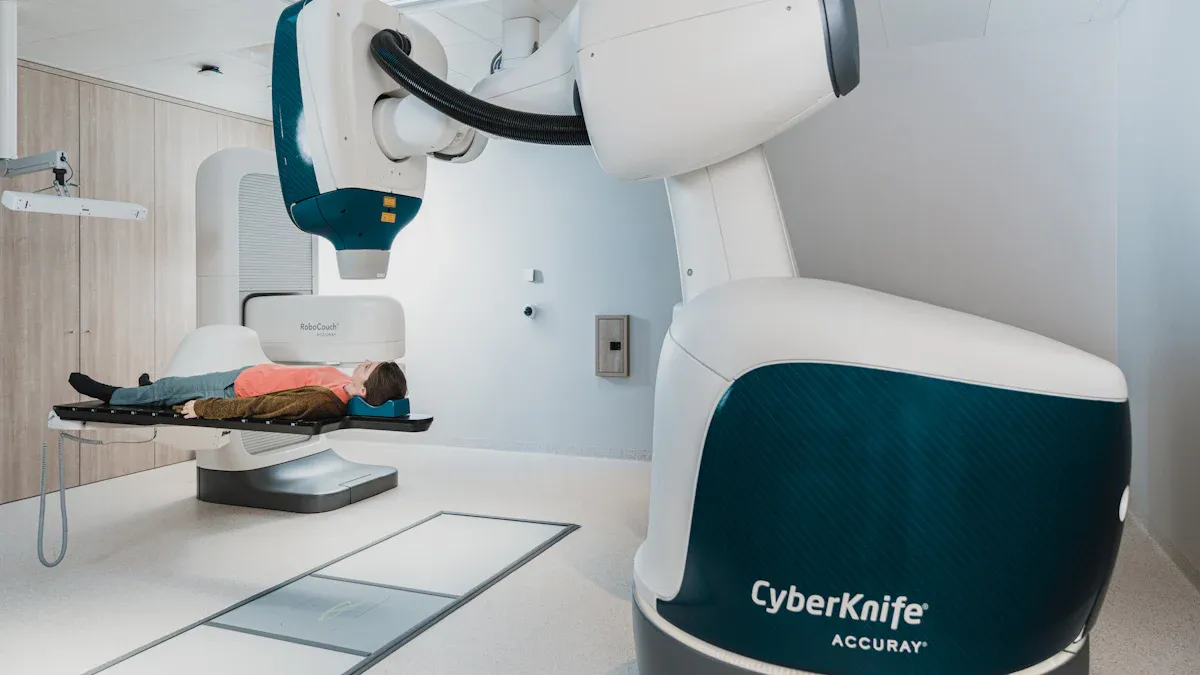
CyberKnife uses a linear accelerator on a robotic arm that moves around your head, delivering radiation from thousands of angles. The system uses real‑time imaging to track the tumor during treatment. The newer Gamma Knife Icon also offers real‑time motion monitoring, so both platforms can track and adjust during a session.
Radiation Delivery: Gamma rays from fixed angles (Gamma Knife) vs. Linear accelerator on a robotic arm (CyberKnife).
Targeting Mechanism: Fixed geometry for brain‑only treatment (Gamma Knife) vs. Real‑time imaging and tracking (CyberKnife).
Number of Angles: ~200 fixed hemispherical beams (Gamma Knife) vs. thousands of robotic beam positions (CyberKnife).
Patient Movement: Requires full immobilization (Gamma Knife) vs. Allows small movements (CyberKnife).
Impact on Healthy Tissue: Steep dose fall‑off (Gamma Knife) vs. Angle flexibility + tracking (CyberKnife).
Treatment Flexibility
When comparing Gamma Knife and CyberKnife, you should consider how flexible each treatment is. CyberKnife stands out for its ability to treat tumors in locations that require extra angular flexibility, including some skull‑base and spinal areas. Gamma Knife also excels at reaching deep, centrally located brain targets that are difficult to access surgically. The robotic arm can move in many directions, so it can target tumors that have odd shapes or are in tricky spots. CyberKnife can also treat tumors that shift slightly with breathing, such as spinal or lung tumors, and may suit some brain tumors that are moderately larger when delivered over multiple sessions — though there are still size limits your doctor must assess.
CyberKnife’s robotic arm makes small, precise adjustments during treatment.
It works well for irregularly shaped tumors.
CyberKnife can treat moving targets, not just those in the brain.
Classic Gamma Knife is limited to single‑session, frame‑based brain treatment — a deliberate design that maximises intracranial accuracy. Newer Icon models add mask‑based, fractionated (2–5 session) options, though they remain brain‑only and do not use a robotic arm.
Patient Comfort
Patient comfort is another key part of comparing Gamma Knife and CyberKnife. With classic Gamma Knife, a stereotactic head frame is fixed to your skull with four temporary pins after local anaesthetic is applied. Most people feel pressure rather than pain, though it can be unsettling. Many centres now offer the mask‑based Gamma Knife Icon, which avoids pins entirely. The frame is usually used for a single treatment session.
Some centers use the Gamma Knife Icon, which can treat patients with a mask instead of a pinned head frame, reducing discomfort and allowing more flexibility in how sessions are scheduled.
CyberKnife uses a soft mesh mask instead of a frame to hold your head in place safely. The mask holds your head in place, but it feels much more comfortable. You do not need any pins or screws. CyberKnife treatments can happen over several sessions, which can make the process easier for you.
Here is a quick look at how each system affects your comfort:
Treatment Method | Immobilization Type | Patient Comfort | Treatment Flexibility |
|---|---|---|---|
Gamma Knife | Rigid head frame | Less comfortable | Usually one session |
CyberKnife | Soft mesh mask | More comfortable | 1-5 sessions possible |
Tip: If you worry about pain or discomfort, you may prefer CyberKnife’s frameless approach.
When you compare Gamma Knife vs. Cyber Knife: Which One’s for Your Brain Tumor?, you will notice that both offer precise treatment, but your comfort and the flexibility of the system can make a big difference in your experience.
Effectiveness and Safety
Success Rates
You want to know how well these treatments work. Both Gamma Knife and CyberKnife can offer high local control for many small, clearly defined brain metastases and certain benign brain tumors, but results vary with the tumor’s type, size, number, and location. Doctors use these systems because they deliver precise radiation and avoid open surgery. Outcomes are not the same for every brain tumor — radiosurgery works best for selected small metastases and certain benign tumors, and your medical team will explain what is realistic for your specific case. Both systems have low rates of serious complications compared to traditional surgery. You may feel reassured knowing that both systems help many patients recover with fewer risks.
Both Gamma Knife and CyberKnife have low complication rates compared to open surgery.
Radiation Precision
Precision matters when treating brain tumors. You want the radiation to hit the tumor and spare healthy tissue. Gamma Knife delivers sub‑millimeter precision, typically ≤0.5 mm. CyberKnife achieves sub‑millimeter accuracy with skull tracking; precision varies by tracking method.
CyberKnife uses real-time imaging and a robotic arm. This technology helps maintain targeting accuracy, which can reduce unintended dose to nearby healthy tissue. The system tracks the tumor and adjusts during treatment. Gamma Knife’s fixed geometry delivers hundreds of converging beams with an exceptionally steep dose drop‑off, providing excellent protection for nearby healthy tissue.
Note: CyberKnife’s flexibility and tracking help protect your brain from extra radiation.
Side Effects
You may experience some side effects after treatment. Most are mild and temporary. Common / Mild Side Effects
Headache
Fatigue
Nausea
Scalp tenderness or irritation
Minor swelling or redness
Rare / Severe Side Effects
Brain swelling (edema)
Neurological changes (numbness, weakness, sensory changes)
Seizures
The Gamma Knife head frame can cause temporary pin‑site discomfort, but radiation‑related side effects are comparable between both treatments. CyberKnife uses a mask, which makes the process less invasive and more comfortable. You can talk to your doctor about ways to manage these side effects.
Treatment Process

Procedure Steps
You may wonder what happens during Gamma Knife or CyberKnife treatment. Both follow a clear process to keep you safe and comfortable. Here is a simple breakdown for each:
Gamma Knife Procedure Steps
Step | Description |
|---|---|
1 | Doctors attach a special frame to your head to keep it still. |
2 | You get brain scans, like MRI or CT, to find the tumor. |
3 | The medical team creates a treatment plan using your scans. |
4 | You lie on a table that moves into the Gamma Knife machine. |
5 | The machine sends focused gamma rays to the tumor. |
6 | Doctors remove the frame and clean the spots where it was attached. |
You meet with your doctor to talk about your treatment.
The team fits you with a soft mesh mask to keep your head still.
You get scans, such as MRI or CT, to map the tumor.
Experts plan your treatment using these images.
The CyberKnife machine delivers radiation while you wear the mask.
You may have one to five sessions, depending on your plan.
Note: Both treatments do not require open surgery. You stay awake and can go home the same day.
Recovery Time
Most people recover quickly after Gamma Knife or CyberKnife treatment. You may feel tired or have a mild headache. Many patients return to normal activities the next day. Some doctors suggest you rest for 24 to 72 hours. You might notice minor side effects, but these usually go away soon. You do not need to stay in the hospital overnight.
You can walk out of the clinic after your session.
You may need to take it easy for a day or two.
Your doctor will give you tips for recovery based on your needs.
Tip: Always follow your doctor’s advice for the best recovery.
Suitability for Different Tumors
Tumor Types
You may wonder which brain tumors doctors treat with Gamma Knife or CyberKnife. Each system works best for certain types. Gamma Knife often treats tumors that are small and located in the brain. Doctors use it for many common brain tumors. Here are some examples:
Brain metastases
Pituitary tumors
Meningiomas
Selected small, well‑defined gliomas (in carefully chosen cases)
Craniopharyngiomas
Not typically used for diffuse or high‑grade gliomas, which usually need other treatments
Acoustic neuromas
CyberKnife delivers stereotactic radiotherapy over 1–5 sessions, which may help treat some tumours that are larger or more irregularly shaped than those typically treated in a single session — though size and safety limits still apply, so very large or widely spread tumours are usually managed with surgery and conventional radiotherapy instead.
Both Gamma Knife and CyberKnife are also used for non‑tumour conditions such as trigeminal neuralgia (severe facial nerve pain) and arteriovenous malformations (abnormal blood‑vessel tangles).
The table below shows some types:
Type of Tumor | Description |
|---|---|
Benign Tumors | Includes conditions like acoustic neuromas. |
Malignant Primary Tumors | Primary brain tumors that are cancerous. |
Brain Metastases | Secondary tumors that have spread to the brain. |
Trigeminal Neuralgia | A painful condition affecting the trigeminal nerve. |
Arteriovenous Malformations (AVMs) | Abnormal connections between arteries and veins. |
CyberKnife has published long‑term data for treating certain central nervous system tumours, including vestibular schwannoma (acoustic neuroma) — a condition Gamma Knife also treats with well‑established outcomes.
Because CyberKnife is not limited to the head, doctors also use it for spinal metastases, but this article focuses on brain tumours. You benefit from precise radiation delivery, which protects healthy tissue.
Tip: Ask your doctor which system fits your tumor type. Some tumors respond better to one treatment than the other.
Tumor Location
Tumor location matters when choosing Gamma Knife or CyberKnife. Gamma Knife is particularly well suited for small, deep, or centrally located brain tumours near sensitive structures, thanks to its fixed‑frame precision and steep dose fall‑off.
CyberKnife is particularly helpful when the tumour is in a location that benefits from its robotic arm's angular flexibility or when fractionated treatment over several days is preferred. You can get treatment for tumors near the skull base, spine, or areas that shift slightly. CyberKnife adapts to tumors with unusual shapes or those that move during breathing.
Gamma Knife suits small, deep, or centrally located brain tumors.
CyberKnife treats tumors in tricky spots, including the skull base and spine.
You should discuss your tumor’s location with your medical team. They help you decide which system gives you the safest and most effective treatment.
Both treatments are not right for everyone. You may not be a candidate if:
Your tumour is very large (typically over 3–4 cm) and causing dangerous pressure inside the skull — surgery may be needed first.
You have many widespread tumours that cannot all be safely targeted.
The tumour is diffuse or infiltrative, without clear borders (for example, most high‑grade gliomas).
You are pregnant — radiation can harm the developing baby.
You have certain implanted medical devices that make MRI planning unsafe.
You cannot lie flat or stay still for the required time, even with support.
Always ask your medical team for a full eligibility assessment.
Pros and Cons
Gamma Knife Pros & Cons
When you look at Gamma Knife, you find many benefits for brain tumor treatment. Doctors often choose this method because it is noninvasive — neither Gamma Knife nor CyberKnife requires general anaesthesia or surgical incisions. You do not need any incisions, so you avoid the risks of open surgery. The system targets brain tumors with high accuracy, often Gamma Knife typically achieves 0.3–0.5 mm precision. You usually experience fewer side effects than with traditional treatments. Many people return to normal activities within two or three days.
Pros of Gamma Knife:
Noninvasive procedure with no incisions
No need for general anesthesia
Highly accurate targeting of brain tumors, including those deep within the brain — a strength shared by both Gamma Knife and CyberKnife.
Side effects are generally mild compared to open surgery, though some people still experience fatigue, headache, or temporary swelling that your team will monitor.
Outpatient procedure with same‑day discharge, as is also typical for CyberKnife.
Can treat multiple small brain tumors in a single session, though there is a limit based on total number, size, and location that your team must evaluate.
Preserves healthy brain tissue
Decades of published clinical data support its safety and effectiveness for selected brain tumors.
However, Gamma Knife also has some drawbacks. If you have a large tumor or one that causes swelling, you may not qualify for this treatment. Gamma Knife works best for small, well-defined tumors. It may not treat tumors that spread out or infiltrate brain tissue. Some people experience post-radiation effects, such as swelling or headaches. The rigid head frame can also cause discomfort.
Cons of Gamma Knife:
Usually not used as the main treatment for high‑grade gliomas, because these tumors spread widely and are better managed with surgery, conventional radiotherapy, and medicines.
Possible post-radiation side effects
Head frame can feel uncomfortable or anxiety‑provoking for some people, though most describe pressure rather than pain after local anaesthetic.
CyberKnife Pros & Cons
CyberKnife offers a different set of advantages. You do not need surgery or a rigid head frame. The system uses a soft mask, which makes the experience more comfortable. CyberKnife can treat tumors in many parts of the body, not just the brain. The robotic arm delivers radiation from many angles and adjusts for movement during treatment.
Pros of CyberKnife | Description |
|---|---|
Non-invasive | No surgery or incisions needed |
Comfort | No rigid head frame, uses a soft mask |
Precision | Pinpoint accuracy, spares healthy tissue |
Versatility | Treats tumors in the brain and other body parts |
Real-time tracking | Adjusts for patient or tumor movement during treatment |
Still, CyberKnife has some limitations. Each CyberKnife treatment fraction may last 30–90 minutes, though the total time per session is often less than a full Gamma Knife day that includes frame fitting, imaging, planning, and delivery. Staying still for the duration of the session can be challenging for some people, including children or elderly patients — though CyberKnife's real‑time tracking tolerates small movements, and both systems have strategies to help you stay comfortable. If you have a very large or widely spread brain tumor, or serious medical problems that make lying still unsafe, radiosurgery with Gamma Knife or CyberKnife may not be suitable, and your doctors may recommend surgery, conventional radiotherapy, or other treatments instead. There is also a moderate risk of mild to moderate side effects, such as fatigue or swelling.
Cons of CyberKnife:
Longer treatment times
Some patients struggle with staying still
Not suitable for all tumor types or locations
Moderate risk of side effects
Tip: Always talk with your doctor about which treatment fits your needs best.
You have two strong options for brain tumor treatment: Gamma Knife and CyberKnife. Each system offers high accuracy and safety. Your best choice depends on your tumor’s size, location, and your comfort needs. Medical experts often use the following features to guide decisions:
Gamma Knife | CyberKnife | |
|---|---|---|
Comfort | Head frame in classic models; some centers use mask-based Icon | Soft mask, non-invasive |
Flexibility | Single-session frame-based; Icon allows 2–5 fractionated sessions with a mask | CyberKnife: plan in advance, treat over 1–5 days. |
Patient Satisfaction | High | High; some patients prefer the frameless approach |
You should always talk with your doctor. Weigh comfort, safety, and flexibility before you decide.
FAQ
What is the main difference between Gamma Knife and CyberKnife?
You will notice that Gamma Knife traditionally uses a head frame (though some centers offer mask-based treatment with the Icon model) and targets brain tumors. CyberKnife uses a soft mask and treats tumors in the brain and other body parts.
Is the treatment painful?
You may feel some discomfort with Gamma Knife because of the head frame. CyberKnife feels more comfortable since you wear a soft mask. Most people do not feel pain during the actual treatment.
How long does each treatment session take?
Classic Gamma Knife is usually completed in a single day, with the entire process — frame placement, imaging, planning, and treatment delivery — taking several hours from start to finish.
CyberKnife may be delivered over one to five sessions; each session lasts roughly 30 to 90 minutes of treatment time, with additional setup before and after.
Can I return to normal activities after treatment?
You can return to most activities the next day. Some people feel tired or have a mild headache. Your doctor will give you advice for a safe recovery.
This article is for educational purposes only and is not a substitute for professional medical advice. For more details, please see our Disclaimer. To understand how we create and review our content, please see our Editorial Policy.
See Also
Exploring The Different Types Of Brainstem Gliomas
Key Characteristics Of Glioblastoma: A Comprehensive Overview
Different Types Of Astrocytomas: An In-Depth Guide

© 2026 Banish Cancer. Banish Cancer is a registered non-profit organization providing evidence-based research, educational courses, and Fear Response AI support services. Reg. No: 305706884 | Address: Taikos pr. 43-603, Kaunas, Lithuania.