Cancer Stem Cell Breakthroughs Shaping Future Treatment

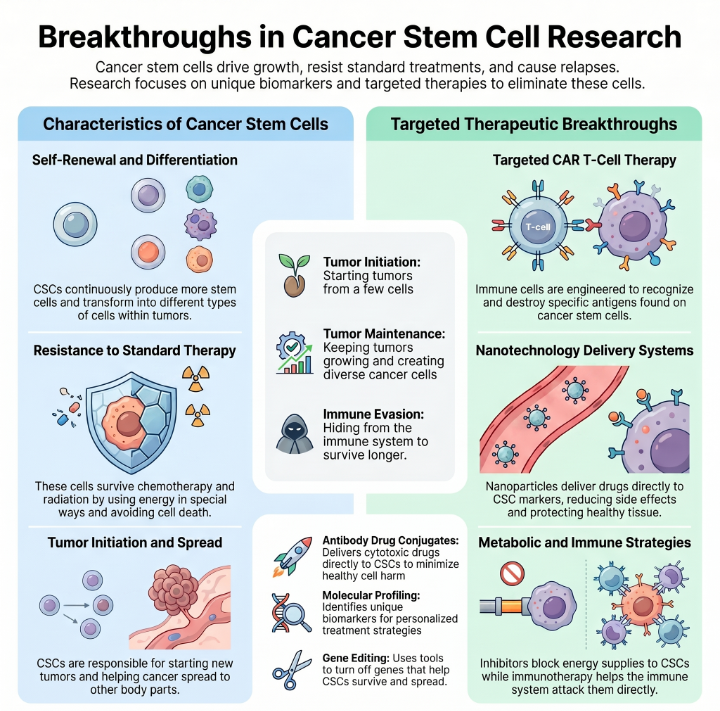
You now witness a rapid wave of discoveries in cancer stem cell research. These advances change how you see cancer therapy and improve hope for many patients. Take a look at the numbers:
Current cancer stem cell therapies are still in early‑stage research. No long‑term survival statistics exist yet for CSC‑targeted treatments, and no clinical trials have shown a survival advantage comparable to standard therapies. Most CSC findings come from laboratory and early‑phase studies, not large patient trials.
The Latest in Cancer Stem Cell Research raises a key question: how do these breakthroughs shape the future of cancer therapy for you?
Key Takeaways
Cancer stem cells are unique and play a crucial role in tumor growth and treatment resistance. Understanding their characteristics can help improve cancer therapies.
New identification methods and biomarkers allow for better detection of cancer stem cells, leading to more targeted and effective treatments.
Combining therapies, such as CAR T-cell therapy and metabolic inhibitors, can enhance treatment effectiveness and reduce the chances of cancer returning.
Personalized medicine focuses on tailoring treatments to individual patients, improving outcomes by targeting the specific features of their cancer.
Overcoming challenges in cancer stem cell research, such as therapy resistance and high treatment costs, is essential for advancing effective cancer treatments.
Understanding Cancer Stem Cells
Defining Cancer Stem Cells
You may wonder what makes cancer stem cells different from other cells in a tumor. Cancer stem cells have unique features that set them apart.
They can renew themselves, which means they keep making more cells like themselves.
They can change into different types of cells found in tumors.
They start and keep tumors growing.
They show special surface markers, such as CD133, CD44, and CD24.
They resist many treatments, making them harder to kill.
They form spheres in serum-free medium, which shows their stem-like nature.
They have high activity of an enzyme called aldehyde dehydrogenase 1.
Scientists confirm their ability to cause tumors in animal tests.
You see these features in The Latest in Cancer Stem Cell Research, where scientists use new tools to find and study these cells. This helps you understand why cancer stem cells matter so much in cancer treatment.
Role in Tumor Growth and Resistance
Cancer stem cells play a big part in how tumors grow and why they come back after treatment.
They help tumors form, spread to other parts of the body, and return after therapy.
If you target cancer stem cells, you can stop their growth and lower drug resistance.
Researchers found that cancer stem cells use several tricks to survive:
Epithelial-mesenchymal transformation (EMT) makes them resist cell death.
EMT helps them move and cause cancer to return.
They avoid dying, which makes treatment harder.
Take a look at this table to see how cancer stem cells affect tumors:
Contribution | Description |
|---|---|
Tumor Initiation | Cancer stem cells start tumors from a few cells, important in early cancer. |
Tumor Maintenance | They keep tumors growing and create many types of cancer cells. |
Immune Evasion | They hide from the immune system and survive longer. |
Another table shows how changes in these cells make cancer tougher to treat:
Mechanism | Impact |
|---|---|
Genetic Alterations | These changes drive cancer and affect how tumors respond to treatment. |
Epigenetic Changes | They control cell growth and make cancer stem cells resist therapies. |
You see that The Latest in Cancer Stem Cell Research gives you new ways to spot and target these cells. This knowledge helps you understand why some cancers keep coming back and how new treatments can make a difference.
The Latest in Cancer Stem Cell Research: Breakthroughs
New Identification Methods and Biomarkers
You now have access to advanced tools that help you find and study cancer stem cells (CSCs) with greater accuracy. The Latest in Cancer Stem Cell Research uses new biomarkers to identify CSCs in different stages of cancer, including before and after treatment. These biomarkers help you understand how cancer grows and changes. They also show you how CSCs can adapt to their environment, which means their features can shift during therapy.
Researchers focus on finding markers that reveal the unique traits of CSCs. For example, scientists look at metabolic reprogramming factors. These factors help you see how normal stem cells turn into cancer stem cells. By studying these changes, you can develop better ways to target and treat cancer.
Note: Not all markers are perfect. Some, like CD133, appear in both normal and cancer stem cells. This makes it hard to tell them apart in solid tumors. You need more specific markers to improve detection and treatment.
Here is a quick look at what you should know about biomarkers:
Marker Type | Usefulness | Challenge |
|---|---|---|
Surface markers (e.g., CD133) | Help identify CSCs | Not always specific to CSCs |
Metabolic markers | Show cell energy changes | Still under study |
Genetic/epigenetic markers | Reveal cell behavior and changes | Need more validation |
The Latest in Cancer Stem Cell Research continues to search for better biomarkers. This work helps you find CSCs more easily and design therapies that target them directly.
Insights into CSC Behavior and Resistance
You see that cancer stem cells play a major role in how tumors start, spread, and come back after treatment. The Latest in Cancer Stem Cell Research shows that CSCs resist many therapies, including chemotherapy and radiotherapy. This resistance makes it hard for you to get rid of cancer completely.
You learn that CSCs can:
Start new tumors and help cancer spread.
Survive treatments that kill other cancer cells.
Change their features to adapt to new environments.
Use energy in a special way, called the Warburg effect, to stay alive.
Scientists now use new methods like single-cell sequencing to study these behaviors. You can see how CSCs change over time and how they avoid being destroyed. Researchers also find that targeting certain enzymes, such as hexokinase 2, can stop CSCs from making energy and growing. Agents like retinoids and vitamin D analogs can make CSCs mature and lose their ability to start tumors.
Tip: Combining drugs that target immune checkpoints with other therapies can boost your immune system and help remove CSCs.
You also discover that CSCs can come from normal stem cells, progenitor cells, or even more mature cells. This plasticity means CSCs can change and survive in tough conditions. Their ability to adapt and interact with their surroundings makes them strong opponents in cancer therapy.
Nanotechnology and Bioengineering Advances
The Latest in Cancer Stem Cell Research brings you new tools from nanotechnology and bioengineering. These advances help you deliver treatments directly to CSCs and make therapies work better.
You benefit from several strategies:
Targeting specific markers on CSCs to deliver drugs right where they are needed.
Modifying signals in the tumor environment to break up CSC groups.
Blocking pumps that CSCs use to push out drugs, making treatments more effective.
Using gene editing tools like CRISPR/Cas9 to turn off genes that help CSCs survive and spread.
You also see that combining traditional chemotherapy with agents that target CSCs, such as Wnt or HDAC inhibitors, can stop tumors from coming back. Adding immune checkpoint inhibitors and epigenetic modulators can help your immune system attack CSCs more strongly.
Callout: Nanoparticles can carry drugs or genetic material straight to CSCs. This approach reduces side effects and increases the chances of killing cancer at its root.
Bioengineering also lets you adjust microenvironment signals and control how CSCs behave. By using these new methods, you can improve the success of cancer treatments and lower the risk of relapse.
The Latest in Cancer Stem Cell Research gives you hope for more precise and powerful therapies. These breakthroughs help you understand cancer better and offer new ways to fight it.
Evolving Therapeutic Strategies for CSCs
CAR T-Cell Therapy Targeting CSCs
CSC‑targeted CAR T‑cell therapies are in early‑phase trials and show promise, but no definitive relapse‑prevention rates exist yet. Current CAR T‑cell success rates apply only to certain blood cancers and do not reflect CSC‑specific outcomes.
You now have access to CAR T-cell therapy, which uses your own immune cells to fight cancer stem cells. Scientists engineer T-cells to recognize antigens like EpCAM, HER2, EGFRvIII, and CSPG4 on cancer stem cells. These T-cells can find and destroy cancer at its root. You see CAR T-cell therapy working well in blood cancers and showing promise in solid tumors. Compared to traditional treatments, CAR T-cells target cancer stem cells directly, making them more effective against resistant cells.
CAR T-cell therapy offers a direct approach to eliminate cancer stem cells, while traditional treatments often miss these targets.
Here is a table showing clinical trials for CAR T-cell therapies targeting cancer stem cell antigens:
Trial ID | Cancer Type | Phase | Status |
|---|---|---|---|
NCT02915445 | Nasopharyngeal carcinoma | Phase I | Recruiting |
NCT02915445 | Breast cancer | Phase I | Recruiting |
NCT02725125 | Stomach neoplasms | Phase I | Recruiting |
NCT02729493 | Liver neoplasms | Phase I | Recruiting |
NCT03392064 | Small cell lung cancer | Phase I | Recruiting |
Metabolic Inhibitors and Combination Approaches
You can use metabolic inhibitors to target cancer stem cells by blocking their energy supply. Drugs like 3-bromopyruvate, 2-DG, dichloroacetic acid, vitamin C, metformin, and TPP attack cancer stem cells and reduce their ability to grow. When you combine these drugs with other treatments, you see better results. For example, co-treatment with 5-FU and metformin lowers stemness markers in colon cancer stem cells. Mitochondrial inhibitors like TPP destroy cancer stem cells but spare normal cells.
Evidence Description | Impact on Cancer Stem Cells |
|---|---|
Co-treatment of 5-FU and metformin reduces stemness markers in colon CSCs. | Diminishes stemness and spherogenesis in colon cancer. |
Doxycycline resistant-CSCs are sensitive to OXPHOS inhibitors. | Enhances effectiveness of metabolism-based drugs. |
Mitochondrial inhibitors like TPP selectively target CSCs. | Annihilates CSCs while sparing normal cells. |
GLS1 inhibitors increase ROS levels, impairing Wnt/β-catenin signaling. | Attenuates CSC properties in hepatocellular carcinoma. |
Sequential treatment with metabolic inhibitors can eradicate CSCs. | Prevents drug resistance and targets CSC metabolism effectively. |
Immunotherapy and Next-Generation Treatments
You benefit from immunotherapy that uses monoclonal antibodies and antibody drug conjugates to target cancer stem cells. These therapies bind to unique markers on cancer stem cells and deliver drugs directly, minimizing harm to healthy cells. Personalized cancer vaccines and checkpoint inhibitors help your immune system recognize and attack cancer stem cells. Programs like stem cell transplantation and cellular therapy improve survival and quality of life. The Latest in Cancer Stem Cell Research shows that next-generation treatments, such as molecular profiling and HIPEC, offer new hope for patients.
Treatment Method | Mechanism |
|---|---|
Immunotherapy | Utilizes the immune system to target cancer stem cells (CSCs) through monoclonal antibodies (MABs). |
Antibody Drug Conjugates (ADC) | Delivers cytotoxic drugs directly to CSCs, minimizing harm to healthy cells. |
Molecular Profiling | Identifies unique biomarkers for personalized treatment strategies. |
Stem Cell Transplantation | Replaces damaged stem cells, improving patient survival and quality of life. |
HIPEC | Delivers heated chemotherapy directly to tumors, reducing systemic side effects. |
Personalized Cancer Vaccines | Tailors vaccines to individual patient profiles to enhance immune response against CSCs. |
Impact on Cancer Treatment and Patient Outcomes
Personalized and Precision Medicine
You now see how cancer stem cell research changes the way doctors treat cancer. By focusing on the unique features of your cancer, doctors can design treatments that fit you better. Targeting cancer stem cells helps you get therapies that work for your specific tumor. This approach improves your chances of a good outcome.
Doctors use biomarkers to understand your cancer and choose the right drugs.
Existing medicines can be repurposed to target cancer stem cells in your body.
AI and microbiome research help predict how you will respond to treatment.
Your own T-cells can be collected and modified with CARs, then given back to you to fight cancer.
These new methods make your treatment more effective and less toxic.
Tip: Personalized medicine means your treatment is not one-size-fits-all. You get care that matches your cancer’s unique traits.
Here is how precision medicine works for you:
Doctors test your tumor for special markers.
They pick drugs or therapies that target those markers.
If needed, they use your own immune cells, change them in the lab, and put them back in your body.
These modified cells can stop cancer from coming back in 76% of cases.
Reducing Relapse and Improving Survival
You want your cancer to stay away after treatment. Cancer stem cell therapies help you reach this goal. These treatments attack the root of the cancer, not just the surface.
Doctors use many strategies to target cancer stem cells, such as blocking surface markers, changing signals in the tumor, and stopping drug pumps.
Therapies that target cancer stem cells can make your cancer less likely to return.
Some treatments combine old and new methods to give you the best chance at survival.
Note: Studies show that using modified T-cells can stop cancer from coming back in most patients.
Strategy | How It Helps You |
|---|---|
Targeting surface markers | Finds and destroys cancer stem cells |
Modulating signaling pathways | Stops cancer stem cells from growing |
Adjusting microenvironment | Makes it harder for cancer to survive |
Inhibiting drug-efflux pumps | Keeps medicine inside cancer cells |
Inducing apoptosis/differentiation | Forces cancer stem cells to die or change |
You benefit from these advances because they lower your risk of relapse and help you live longer. Cancer stem cell research gives you hope for a future with better treatments and better outcomes.
Challenges and Future Directions
Overcoming Therapy Resistance
You face a tough challenge when cancer stem cells resist treatment. These cells use many tricks to survive, making your therapy less effective. Scientists have found promising ways to fight this resistance. You can look at natural compounds for help. Dietary phytochemicals, such as polyphenols, flavones, and terpenes, target cancer stem cells and slow their growth. Nutritional herbs from traditional Chinese medicine also show strong effects in lab models for triple-negative breast cancer. Herbal agents like androgopholide, baicalin, and berberine work well in breast cancer stem cell models.
These compounds act on important pathways that cancer stem cells use to survive. You see them affecting Wnt/β-catenin, Notch, Hedgehog, and TGF-β pathways. They also block survival signals like PI3K, AKT, and mTOR, which play a role in chemo-resistance.
Tip: Combining these natural agents with standard treatments may help you overcome resistance and improve your chances for recovery.
Here is a quick list of strategies that show promise:
Use dietary phytochemicals to target cancer stem cells.
Apply herbal formulations to block growth and survival pathways.
Combine bioactive agents with chemotherapy for better results.
Translating Research to Clinical Practice
You want new discoveries to reach patients quickly, but several barriers stand in the way. Cancer stem cell research faces challenges that slow progress. Biomarker levels change over time, which can lead to drug resistance and make it hard to develop targeted therapies. Ethical concerns in clinical trials may stop patients from joining, especially when unknown side effects exist. Tumor evolution creates new, resistant cancer stem cell groups, making universal treatments difficult.
You also see practical issues. High costs for chemotherapeutic drugs limit access for many patients. Research and development need significant funding, which is not always available. Multidrug resistance, caused by genetic factors and increased drug metabolism, leads to treatment failure.
Note: You need better funding, safer clinical trials, and more precise biomarkers to bring these breakthroughs to the clinic.
Here is a summary of key barriers:
Dynamic biomarker expression complicates therapy development.
Ethical concerns reduce clinical trial participation.
Tumor evolution creates resistant cell populations.
High treatment costs limit patient access.
Funding gaps slow research progress.
Multidrug resistance leads to therapy failure.
You see that overcoming these challenges will shape the future of cancer treatment and help more patients benefit from new therapies.
You see cancer stem cell research changing the future of cancer care. New therapies give you hope for better results and fewer relapses. Scientists focus on many cancers, such as breast, lung, brain, prostate, and colorectal, by finding unique markers and testing new treatments.
Here are some top areas for innovation:
Area of Innovation | Description |
|---|---|
Targeting Key Signaling Pathways | Focus on Wnt, Notch, and Hedgehog pathways that control cancer stem cells. |
CD47 Antibodies | Help your immune system find and attack cancer stem cells. |
Nano-Drug Delivery Systems | Send medicine straight to cancer stem cells, protecting healthy tissue. |
Advancing Immunotherapy | Train your immune system for long-lasting cancer defense. |
You can follow progress through NCI, American Cancer Society, and Stand Up To Cancer clinical trial resources. Stay curious—new breakthroughs are on the way.
FAQ
What are cancer stem cells?
Cancer stem cells are special cells in tumors. You see them start new tumors and help cancer grow. They resist many treatments and can cause cancer to return.
How do doctors find cancer stem cells?
Doctors use biomarkers and advanced tools like single-cell sequencing. You see them test for surface markers, genetic changes, and metabolic features to spot cancer stem cells.
Can new treatments target cancer stem cells?
Yes. You benefit from therapies like CAR T-cells, metabolic inhibitors, and immunotherapy. These treatments focus on cancer stem cells and help stop cancer from coming back.
Why do cancer stem cells cause relapse?
Cancer stem cells survive after treatment. You see them hide from your immune system and resist drugs. They start new tumors, which makes cancer return.
This article is for educational purposes only and is not a substitute for professional medical advice. For more details, please see our Disclaimer. To understand how we create and review our content, please see our Editorial Policy.
See Also
A Comprehensive Guide to Glioblastoma's Main Features
Exploring Symptoms and Treatment Options for Duodenal Cancer
Key Characteristics and Insights About Hemangioblastoma
Cholangiocarcinoma: Key Features and Insights You Should Know

© 2026 Banish Cancer. Banish Cancer is a registered non-profit organization providing evidence-based research, educational courses, and Fear Response AI support services. Reg. No: 305706884 | Address: Taikos pr. 43-603, Kaunas, Lithuania.