New Phase 2a Trial Targets ctDNA‑Positive CRC

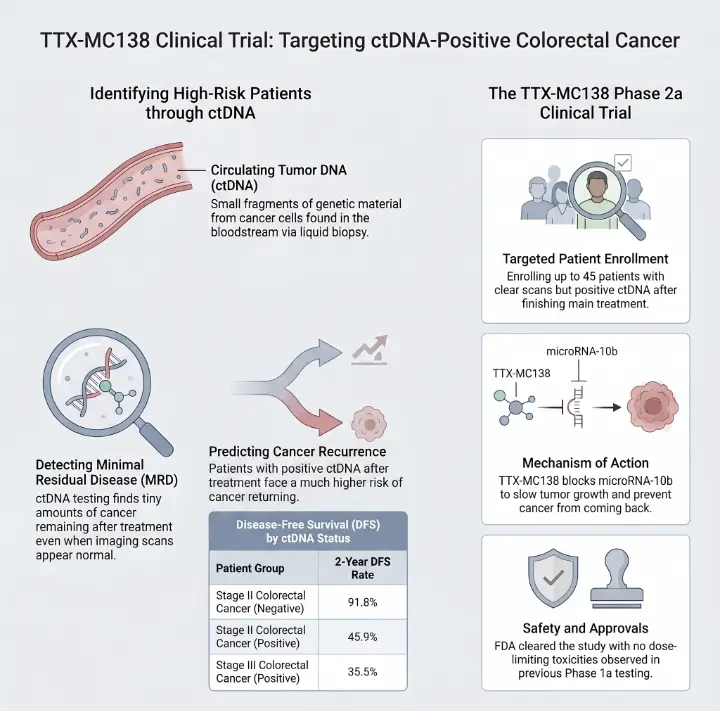
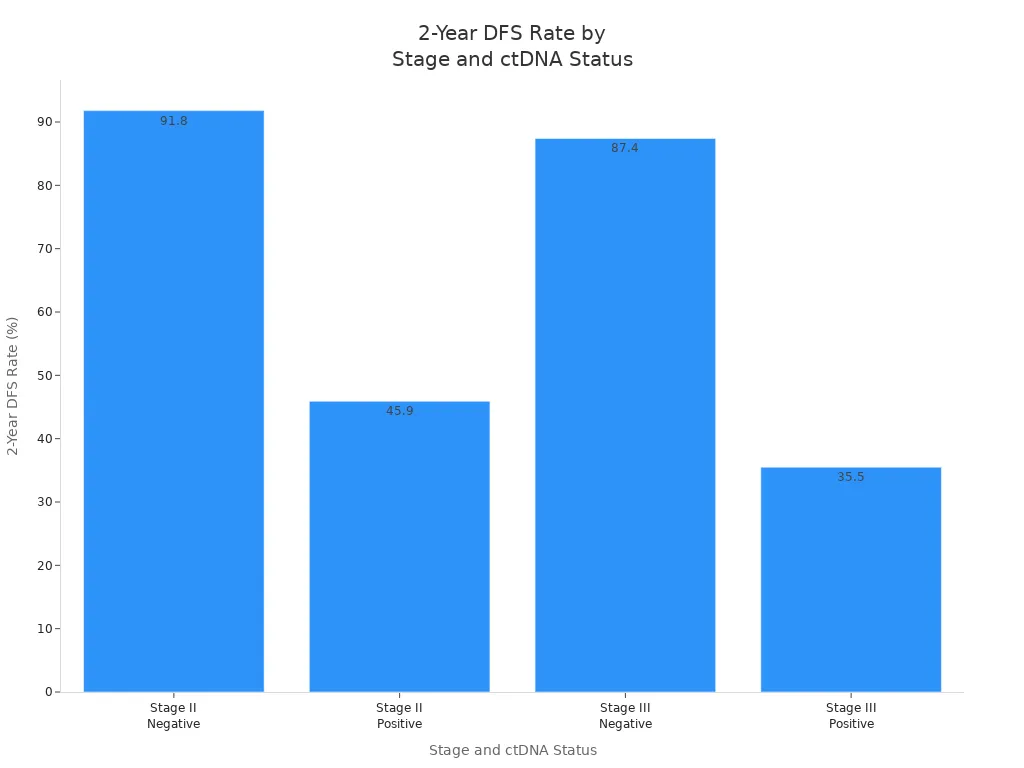
TransCode Therapeutics has launched the TTX-MC138 clinical trial in colorectal cancer for patients who test positive for circulating tumor DNA (ctDNA) after finishing their main treatment. ctDNA testing helps doctors find signs of cancer returning before scans can see it. The table below shows that patients with positive ctDNA have a much higher risk of recurrence than those with negative ctDNA.
Patient Group | ctDNA Status | Median DFS (Months) | |
|---|---|---|---|
Stage II Colorectal Cancer | Negative | 91.8% | Not Reached |
Stage II Colorectal Cancer | Positive | 45.9% | 12.7 |
Stage III Colorectal Cancer | Negative | 87.4% | Not Reached |
Stage III Colorectal Cancer | Positive | 35.5% | 16.2 |
The new partnership with Quantum Leap Healthcare Collaborative and the PRE-I-SPY platform brings more sites and expert teams to the study. This collaboration helps reach more patients and gives hope for better outcomes.
The trial targets people at high risk for cancer coming back.
Early action could make a big difference for patients and their families.
Key Takeaways
TransCode Therapeutics has launched a clinical trial for TTX-MC138, targeting colorectal cancer patients with positive ctDNA, aiming to reduce cancer recurrence.
ctDNA testing allows for early detection of cancer recurrence, providing doctors with critical information to guide treatment decisions.
The trial collaborates with expert centers and platforms to enhance patient access and improve the quality of research.
Using ctDNA to guide therapy can personalize treatment, potentially reducing unnecessary chemotherapy while maintaining patient outcomes.
The TTX-MC138 trial represents a significant step in advancing cancer care, focusing on patients at high risk for recurrence.
TTX-MC138 Clinical Trial in Colorectal Cancer: Design & Overview

Patient Selection & Enrollment
The TTX-MC138 clinical trial in colorectal cancer focuses on patients who have finished their main cancer treatment. These patients show no signs of disease on scans, but their blood tests reveal ctDNA. This means they have minimal residual disease, which puts them at higher risk for cancer coming back. The trial plans to enroll up to 45 patients who meet these criteria.
The main goals of the study include:
Measuring how well TTX-MC138 works in patients with minimal residual disease.
Checking if the treatment can lower the chance of cancer returning in ctDNA-positive patients.
Learning more about how ctDNA testing helps guide treatment decisions for this group.
Patients should verify eligibility and enrollment criteria through official clinical trial listings or with their oncology team, especially for the 45‑patient Phase 2a study.
Investigators & Sites
Many expert centers take part in the TTX-MC138 clinical trial in colorectal cancer. The table below lists the principal investigators and their institutions:
Principal Investigator | Affiliation |
|---|---|
Dr. Emil Lou | University of Minnesota |
Dr. Zhaohui Jin | Mayo Clinic Comprehensive Cancer Center |
Dr. Paula Pohlmann | MD Anderson Cancer Center (Trial Chair) |
These investigators lead the study at top cancer centers. Their experience helps ensure the trial runs smoothly and collects high-quality data.
Regulatory Approvals
TransCode Therapeutics has received important approvals to start the trial. The U.S. Food and Drug Administration (FDA) has cleared the study. The Dana Farber Cancer Institute has also given approval through its Institutional Review Board (IRB). These steps show that the trial meets strict safety and ethics standards.
Note: Regulatory approvals help protect patient safety and ensure the study follows all rules.
The TTX-MC138 clinical trial in colorectal cancer brings together expert teams, careful patient selection, and strong oversight. This design helps researchers learn if early treatment can make a real difference for patients at risk of recurrence.
ctDNA Testing in Oncology

What Is ctDNA?
Circulating tumor DNA (ctDNA) refers to small fragments of genetic material from cancer cells found in the bloodstream. Doctors can collect ctDNA through a simple blood draw, also called a liquid biopsy. This method causes less discomfort than traditional tissue biopsies and allows for repeated testing over time. ctDNA gives real-time information about the cancer’s genetic changes. It helps doctors monitor how much cancer remains in the body and how the disease responds to treatment.
ctDNA offers a non-invasive way to track cancer.
It reflects the current state of the tumor, including changes that may not appear on scans.
ctDNA levels often match the amount of cancer present.
Detecting Minimal Residual Disease
Minimal residual disease (MRD) means tiny amounts of cancer remain after treatment, even when scans look normal. ctDNA testing can find MRD earlier than imaging. Studies show that ctDNA positivity after surgery signals a much higher risk of cancer coming back. For example, the GALAXY Study found that patients with positive ctDNA during the MRD window had a much higher chance of recurrence. Patients who cleared ctDNA after chemotherapy had better outcomes.
Study Name | Key Findings |
|---|---|
GALAXY Study | ctDNA positivity linked to high recurrence risk; clearance after chemotherapy improved 2-year DFS (89% vs. 3%) |
Prior Study | ctDNA positivity after surgery increased recurrence risk sevenfold |
BESPOKE Study | Negative ctDNA-MRD linked to longer disease-free survival |
Guiding Treatment Decisions
Doctors use ctDNA results to make important choices about cancer care. A positive ctDNA test may lead to more treatment or closer monitoring. In stage II colon cancer, ctDNA positivity can support the need for chemotherapy. In stage III, it may prompt doctors to consider clinical trials. Research shows that ctDNA testing changes treatment plans for about one in six patients.
ctDNA testing helps personalize therapy, aiming to give each patient the right treatment at the right time.
Scientific Rationale
Targeting microRNA-10b
Researchers have identified microRNA-10b (miR-10b) as an important biomarker in colorectal cancer. High levels of miR-10b often appear in patients with larger tumors and more aggressive disease. Scientists have found that:
miR-10b links to increased tumor invasion and spread.
Patients with higher miR-10b levels often have advanced cancer stages.
Poorly differentiated tumors show more miR-10b.
Survival rates drop when miR-10b levels rise.
By targeting miR-10b, doctors hope to stop cancer from growing and spreading. This approach could help patients with minimal residual disease after standard therapy.
Mechanism & Early Data
TTX-MC138 works by blocking miR-10b in cancer cells. This action aims to slow tumor growth and prevent cancer from coming back. Early studies have shown promising results. The table below highlights key findings from preclinical and early clinical research:
Evidence Type | Details |
|---|---|
Mechanism of Action | Inhibitor of microRNA-10b |
Safety Profile | No significant treatment-related safety events or dose limiting toxicities observed |
Efficacy | 44% of patients had stable disease lasting 4 months or longer |
Treatment Duration | Median of 4 months, with a range of 2 to 12 cycles |
Pharmacodynamic Effects | Positive effects observed across all dose levels |
Notable Case | Note: This thyroid cancer case occurred in the earlier Phase 1a basket solid‑tumor safety trial, not in the colorectal‑specific Phase 2a study. |
These results support further study of TTX-MC138 clinical trial in colorectal cancer.
Safety from Phase 1a
Safety remains a top priority in cancer research. In the Phase 1a trial, doctors treated 16 patients with TTX-MC138. The table below summarizes the safety outcomes:
Outcome Description | Result |
|---|---|
Dose-limiting toxicities | None |
Total patients treated | 16 |
Total doses administered | 86 |
Evaluable patients | 14 |
Patients achieving stable disease (≥6 months) | 9 (64%) |
Notable case: Thyroid cancer patient Note: This thyroid cancer case occurred in the earlier Phase 1a basket solid‑tumor safety trial, not in the colorectal‑specific Phase 2a study. | 12 months of stable disease |
The Phase 1a trial showed no dose-limiting toxicities. Most patients tolerated the treatment well. These findings gave researchers confidence to move forward with the Phase 2a study.
Collaboration & Platforms
Quantum Leap Healthcare Collaborative
Quantum Leap Healthcare Collaborative plays a key role in improving clinical trial quality and speed. Their trial matching services help more patients find and join studies quickly. The mobile platform increases equity, making it easier for people from different backgrounds to participate. This approach helps researchers enroll patients faster and ensures that more individuals have access to new therapies. The partnership with Quantum Leap Healthcare Collaborative supports the trial’s goal of reaching ctDNA-positive colorectal cancer patients who need early intervention.
Collaboration with organizations like Quantum Leap Healthcare Collaborative helps bring innovative treatments to patients sooner.
PRE-I-SPY Platform
The PRE-I-SPY platform accelerates the evaluation of new oncology therapies such as TTX-MC138. The platform builds on the successful I-SPY model and focuses on earlier-phase studies. It offers several advantages:
Rapid assessment of safety and early efficacy in targeted patient groups.
Access to a network of top clinical sites for faster enrollment.
Streamlined operations that shorten drug development timelines.
Focus on minimal residual disease, which is often missed by standard tests.
Adaptive trial designs that allow flexible and ethical research methods.
Evidence Type | Description |
|---|---|
Bayesian Adaptive Designs | These designs improve efficiency and flexibility in oncology trials. |
Historical Data Utilization | The platform uses past data to optimize randomization and reduce patient numbers. |
Cost and Ethical Risk Reduction | Innovative designs lower costs and ethical risks, speeding up new treatments. |
The PRE-I-SPY platform aims to complete analysis within 12 to 18 months, much faster than traditional trials.
Role of Expert Centers
Expert centers contribute to the success and reliability of multi-site clinical trials. They provide specialized knowledge in oncology subspecialties. These centers see many patients, which helps with rapid enrollment. They also have advanced trial management systems and dedicated Phase I units. This expertise ensures that the trial collects high-quality data and follows strict protocols.
Specialized expertise in cancer research.
Consistent patient volume for quick enrollment.
Advanced trial management and dedicated units.
Expert centers help make clinical trials more reliable and efficient, improving outcomes for patients.
Impact & Future Directions
Reducing Recurrence
Doctors hope that ctDNA-guided therapy will lower the chance of cancer coming back. Studies show that using ctDNA to guide treatment can help patients avoid unnecessary chemotherapy while still keeping recurrence rates low.
In the DYNAMIC‑II trial, ctDNA‑guided treatment resulted in similar 2‑year recurrence‑free survival compared to standard management (88% vs 87%), while reducing chemotherapy use by about half.
The DYNAMIC-II trial found that ctDNA-guided decisions for stage II colon cancer led to fewer patients getting chemotherapy, but recurrence-free survival stayed the same as with standard care.
Most ctDNA-positive patients who received treatment cleared their ctDNA by the end of therapy. Those who cleared ctDNA had a five-year recurrence-free probability of 97%.
These results suggest that ctDNA-guided therapy can help doctors act early and prevent cancer from returning.
Advancing ctDNA-Guided Therapy
The TTX-MC138 clinical trial in colorectal cancer aims to move the field forward by testing a new way to target minimal residual disease. The trial will enroll up to 45 patients who have finished their main treatment but still have ctDNA in their blood. The main goal is to remove any leftover cancer cells and stop recurrence.
Aspect | Details |
|---|---|
Trial Name | TTX-MC138 |
Target | microRNA-10b |
Patient Population | ctDNA-positive colorectal cancer patients with minimal residual disease |
Objective | Evaluate safety, efficacy, and ability to reduce circulating tumor DNA levels |
Potential Impact | May provide a new treatment option to prevent cancer recurrence in high-risk patients |
Importance of ctDNA Testing | Detects residual cancer cells that traditional imaging may miss |
This early intervention approach could change how doctors care for patients after their main cancer treatment.
Implications for Patients
ctDNA-guided therapy offers several long-term benefits for patients and the oncology community.
ctDNA detection of minimal residual disease is one of the strongest known predictors of colon cancer recurrence.
Using ctDNA to guide treatment can cut chemotherapy use by about half without hurting patient outcomes.
Regular ctDNA monitoring helps doctors see how well treatment works and spot recurrence sooner.
Patients may receive more personalized care, fewer side effects from unnecessary treatments, and better long-term outcomes.
The TTX-MC138 clinical trial in colorectal cancer could help set new standards for using ctDNA to guide therapy and improve patient lives.
The TTX-MC138 trial stands out as an innovative step in ctDNA-guided cancer therapy. It targets patients with minimal residual disease, offering early intervention and personalized care. This approach addresses a critical gap for those at high risk of recurrence. The collaboration with expert centers and advanced platforms supports rapid progress.
Description | |
|---|---|
Evaluation of Activity | Assess the biological and clinical activity of TTX-MC138 in ctDNA-positive colorectal cancer patients. |
Data on ctDNA Testing | Gather new insights on ctDNA testing and its potential role in reducing cancer recurrence risk. |
Ongoing enrollment and future results may shape new standards in cancer care. Readers can follow updates as ctDNA-guided therapies continue to advance.
FAQ
What is TTX-MC138?
TTX-MC138 is an experimental drug that blocks microRNA-10b. Researchers believe this action may stop cancer cells from growing and spreading. The drug is now in a Phase 2a trial for colorectal cancer patients with ctDNA in their blood.
Who can join the TTX-MC138 trial?
Patients who finished main treatment for colorectal cancer and have no visible disease on scans but test positive for ctDNA may qualify. Doctors at participating centers decide if someone meets all criteria.
Why is ctDNA testing important?
ctDNA testing finds tiny traces of cancer in the blood. This helps doctors detect cancer returning earlier than scans. Early detection gives patients more treatment options and may improve outcomes.
Is TTX-MC138 safe?
Early studies show TTX-MC138 has a good safety profile. Most patients tolerated the drug well. Doctors did not see any dose-limiting toxicities in the Phase 1a trial.
This article is for educational purposes only and is not a substitute for professional medical advice. For more details, please see our Disclaimer. To understand how we create and review our content, please see our Editorial Policy.
See Also
Exploring Rhabdoid Phenotype In Large Cell Lung Cancer
Recognizing Symptoms And Treatments For Duodenal Cancer
Essential Information About Carcinoid Tumors You Need
Treatment Approaches For Acute Myeloid Dendritic Cell Leukemia
Simplified Explanation Of Causes Behind Gastrointestinal Stromal Tumors

© 2026 Banish Cancer. Banish Cancer is a registered non-profit organization providing evidence-based research, educational courses, and Fear Response AI support services. Reg. No: 305706884 | Address: Taikos pr. 43-603, Kaunas, Lithuania.