Precision Medicine in Cancer: Top 2026 Diagnostic Trends

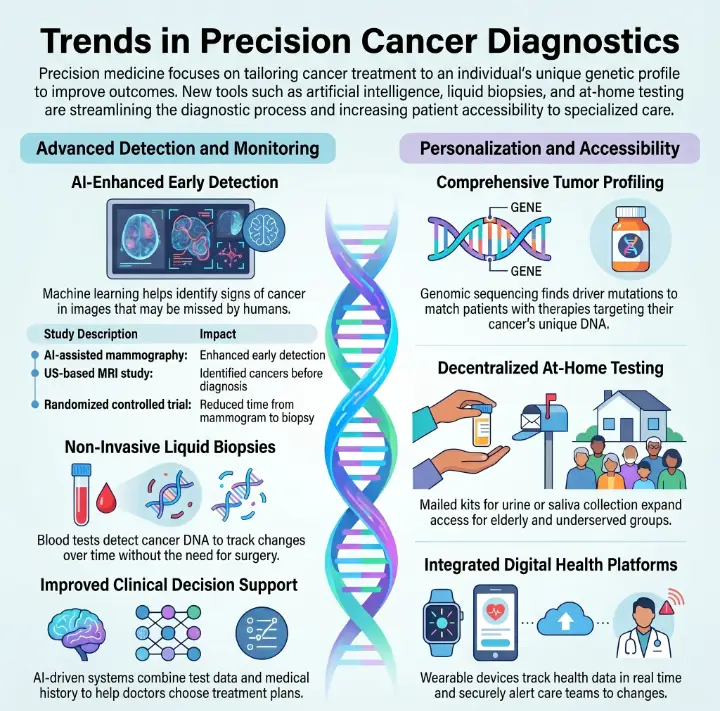
You see cancer diagnostics changing faster than ever. Today, The Future of Cancer Diagnostics: Precision Medicine gives you new hope for earlier and more accurate results.
Global cancer cases are rising sharply.
By 2040, experts expect 28 million more cases and 16.2 million deaths worldwide.
You now have access to powerful new tools. For example:
Technology/Test | Description |
|---|---|
A blood test that detects gene changes in many solid tumors and is FDA‑approved as a companion diagnostic for specific targeted therapies. | |
Multi‑Cancer Early Detection (MCED) tests | Multi‑cancer early detection (MCED) blood tests in development can detect signals from many cancer types, but they are not yet standard screening tools. |
These changes shape how you receive care and what you can expect in the years ahead.
Key Takeaways
Precision medicine tailors cancer treatment to your unique genetic profile, improving outcomes and options.
AI technologies enhance early cancer detection, allowing for quicker diagnoses and timely treatments.
Liquid biopsies offer a less invasive way to monitor cancer, providing accurate results from blood tests.
At-home testing kits increase accessibility, enabling you to engage in your health care from home.
Stay informed about new diagnostic options and ask your care team how advancements can benefit your treatment.
AI in Cancer Diagnostics
Early Detection with Machine Learning
You now see machine learning helping doctors find cancer earlier and more accurately. AI models can scan images and spot signs of cancer that humans might miss. For example, AI-assisted mammography in Sweden Detected 29% more cancers with no increase in false positives. You can see how AI speeds up diagnosis and helps doctors act faster. The table below shows how AI improves early detection:
Study Description | Result | Impact |
|---|---|---|
AI-assisted mammography in Sweden | Detected 29% more cancers | No increase in false positives |
Randomized controlled trial | Reduced time from mammogram to biopsy by 30% | No missed cancers |
Study with nearly half a million women | Improved breast cancer detection by nearly 18% | Enhanced early detection |
US-based MRI study | Predicted breast cancer up to 1 year in advance | Identified 30% of cancers before diagnosis |
AI models like Sybil analyze CT scans to predict lung cancer risk years ahead. AI algorithms for pancreatic cancer identify risk up to three years before diagnosis. You benefit from these advances because doctors can start treatment sooner.
AI for Pathology and Imaging
You notice that AI-powered tools now help doctors read slides and scans with greater accuracy. Digital microscopy reduces mistakes and subjectivity found in traditional methods. AI-based imaging has improved breast, colorectal, and prostate cancer detection. For example:
AI-assisted colonoscopy increases polyp detection rates, helping prevent colorectal cancer.
AI-based imaging tools personalize prostate cancer treatment.
AI models forecast how you might respond to therapies, especially immunotherapies.
These tools speed up disease detection and support timely treatment. You get results faster and more reliably.
Clinical Decision Support
AI-driven systems help doctors choose the best treatment for you. These tools combine data from scans, tests, and your medical history. The ArteraAI Prostate Test predicts patient outcomes better than traditional methods. AI systems improve clinician satisfaction and reduce errors, which leads to better care for you. Cancer centers use AI to risk-stratify patients and support personalized decisions. AI predicts how you will respond to treatments, making your care more precise.
Tip: Ask your doctor if AI tools are part of your diagnostic process. You may benefit from faster and more accurate results.
Genomic Sequencing Advances
Comprehensive Tumor Profiling
You now have access to next-generation sequencing (NGS) that makes tumor profiling faster and more affordable. NGS can read your entire genome or focus on key regions. This technology helps doctors find important gene changes, called driver mutations, that can guide your treatment. You benefit from NGS because it:
Speeds up the process of finding cancer-causing mutations.
Lowers the cost of genetic testing.
Helps doctors match you to the right therapy based on your tumor’s unique DNA.
Comprehensive tumor profiling finds more actionable mutations. Patients who receive complete genomic testing have a higher chance of finding a treatment that fits their cancer. You may see better results and more options for care.
Personalized Treatment Plans
You can receive a treatment plan designed just for you. Doctors use your tumor’s genetic profile to choose therapies that target your cancer’s weak spots. This approach improves your chances of a good outcome. The table below shows how genomically-matched treatments help patients:
Study/Trial | Objective Response Rate | Progression-Free Survival | Overall Survival |
|---|---|---|---|
Genomically-matched treatments | 4.0 vs 2.8 months | 10-year survival: 6% vs 1% | |
ROME study | 17% vs 9.5% | 3.7 vs 2.8 months | N/A |
Doctors use digital health tools and artificial intelligence to read your genetic data. Multidisciplinary tumor boards help make sense of complex results. These teams often change treatment plans based on what they find in your genes.
Note: Ask your care team if your treatment plan uses your tumor’s genetic information. This can lead to better results.
Liquid Biopsy Innovations
You can now get a liquid biopsy, which is a blood test that looks for cancer DNA. This test is less invasive than a tissue biopsy. Liquid biopsies can:
Detect cancer cells and DNA with high sensitivity.
Track how your cancer changes over time.
Use new methods, like nanotechnology, to find tiny signals from tumors.
Analyze many types of body fluids, such as urine or spinal fluid.
Use artificial intelligence to study large amounts of data.
Some liquid biopsy tests, like Guardant360, can find changes in dozens of cancer genes from a single blood sample. These tests match tissue biopsy results most of the time. However, liquid biopsies may miss some mutations, especially in certain cancers. You may need both liquid and tissue biopsies for the most accurate results.
Decentralized and At-home Diagnostics

Home-based Cancer Testing
You can now test for cancer from the comfort of your home. Home-based kits let you collect samples like urine or saliva. Early research suggests urine‑based tests may detect signals from multiple cancers. A few candidates have received Breakthrough Device Designation, but none are approved or available for routine screening. The technology processes your sample and sends results to your smartphone. This gives you quick answers and helps you stay engaged in your care.
Evidence Type | Description |
|---|---|
Mailed Test Kits | These kits expand access to cancer screening, especially for underserved groups. |
Mobile Screening Units | These units increase early detection rates and reduce gaps in cancer prevention. |
You may notice more people using these tools. They help doctors find cancer earlier and reach people who cannot visit clinics easily.
Tip: If you receive a mailed test kit, follow the instructions carefully to get the most accurate results.
Improving Accessibility and Convenience
You benefit from decentralized testing because it makes cancer checks easier and faster. Elderly patients often struggle with travel. At-home tests remove this barrier. Every minute counts when starting treatment. Faster results can improve your outcome.
Decentralized testing increases convenience by reducing trips to the hospital.
Point-of-care testing now helps with early detection and ongoing monitoring.
Saliva-based tests, like those for oral cancer, show how easy and accessible new options have become.
The push for fast, accurate, and accessible diagnostics drives this trend.
Decentralization boosts productivity and quality of care.
You get more control over your health and spend less time waiting for answers.
Integration with Digital Health Platforms
You can connect your at-home test results to digital health platforms. Wearables like smartwatches and rings track your heart rate, ECG, and blood oxygen. Bluetooth devices send your data securely to your doctor. This helps your care team spot problems early and adjust your treatment quickly.
Wearables and smart devices monitor your health in real time.
Doctors can check your progress remotely and respond to changes.
You receive alerts if something needs attention during your cancer therapy.
These tools give you and your care team more information and support. You stay informed and involved in your cancer care journey.
Note: Some barriers to at-home testing include concerns about privacy, lack of internet access, and difficulty using new devices. Ask for help if you face these challenges.
Data Analytics and Forecasting
Predictive Modeling for Outcomes
You now see how big data and machine learning change cancer care. These tools help doctors predict how cancer will behave and how you might respond to treatment. Machine learning algorithms, such as Artificial Neural Networks and Decision Trees, analyze tumor features, gene expression, and patient demographics. This approach gives you a more accurate forecast of your outcome. Doctors use these models to plan your therapy and even to find new cancer drugs. Risk prediction models also help you understand your chances of getting cancer based on your age and genetics.
Big data analytics finds patterns in cancer cases and outcomes.
AI tools detect hidden signals in medical images and genetic data.
Predictive models improve precision medicine by matching you to the best treatment.
A study at Stanford Medical School used genomic sequencing to create a risk score for breast cancer. Larger differences in these scores led to better predictions for patients.
Population Health Insights
Population health insights from large cancer data sets now shape public health strategies. You benefit because doctors can make better treatment decisions and spot cancer earlier. Big data and AI help researchers find health gaps and predict how groups of people will respond to treatments. This leads to more personalized care and helps prevent cancer before it starts.
The future of digital health in oncology will bring even smarter analytics tools. These tools will use information from your genes, lifestyle, and medical images to catch cancer sooner and improve care for everyone.
Proactive Patient Management
You gain from proactive patient management powered by data analytics. Doctors can now spot patients at risk for treatment interruptions or severe symptoms. They reach out early and adjust care plans before problems get worse. Studies show that early palliative care can improve survival by almost five months for advanced cancer patients. Clinic-based symptom monitoring also extends life and boosts quality of life.
AI-enhanced analytics help your care team identify when you need extra support. This means you get help before issues become serious, leading to better treatment results and a smoother cancer journey.
The Future of Cancer Diagnostics: Precision Medicine
Patient-centric Care Models
You will see a major shift toward patient-centric care in the coming years. The Future of Cancer Diagnostics: Precision Medicine puts you at the center of every decision. Healthcare providers now focus on your outcomes, not just the number of tests or treatments you receive. This approach rewards better results for you and your family.
Aspect of Patient-Centric Care | Description |
|---|---|
Value-Based Care Models | Healthcare providers are shifting towards models that reward patient outcomes rather than the volume of services provided. |
Integration of Digital Technologies | The use of wearable devices and remote monitoring is becoming essential in clinical trials and patient care, enhancing data collection and analysis. |
You can use wearable devices and remote monitoring tools to track your health. These tools help your care team collect data and adjust your treatment quickly. The Future of Cancer Diagnostics: Precision Medicine also means you get more personalized care, which can lead to better results.
The market for precision medicine in cancer diagnostics is growing fast. Market analysts project the precision‑medicine diagnostics sector may exceed $250 billion by 2030. Oncology will lead this growth, making up more than half of the market. You will benefit from new technologies that improve accuracy and personalize your treatment.
Regulatory and Policy Innovations
You will notice that new rules and policies make it easier for you to access advanced diagnostics. The Future of Cancer Diagnostics: Precision Medicine depends on smart regulations that speed up the approval of new tests and treatments.
Evidence Description | Impact on Precision Medicine |
|---|---|
FDA's proposed down-classification of oncology companion diagnostics from Class III to Class II | Streamlines approval process and expands access to precision medicine in cancer diagnostics. |
Creation of a new device type for Nucleic Acid-Based Test Systems | Accommodates essential and CDx adjacent tests, enhancing patient access to targeted therapies. |
Potential easing of approval path for oncology companion diagnostics | Could accelerate development timelines and expand access to precision testing for cancer patients. |
You will see more countries working together to support innovation. Global health systems invest in better data and real-world evidence. They also work to create shared standards for sample preparation and data sharing. These changes help you get the latest tests faster and make sure you receive the best care possible.
Tip: Stay informed about new diagnostic options. Ask your care team how policy changes might affect your treatment choices.
You now see how The Future of Cancer Diagnostics: Precision Medicine transforms your care. These trends help you get faster, more accurate results and lower costs through telehealth and advanced decision support.
You benefit from new treatments, but you may notice higher costs for some therapies.
Big data and machine learning improve your outcomes and wellness.
Experts predict that The Future of Cancer Diagnostics: Precision Medicine will bring better liquid biopsies, new biomarkers, and earlier therapy. You can stay informed and ask your care team how to use these advances for your health.
FAQ
What is precision medicine in cancer diagnostics?
Precision medicine means your doctor uses your genes, lifestyle, and environment to find the best cancer treatment for you. This approach helps you get care that fits your unique needs.
How does AI help detect cancer earlier?
AI scans your medical images and finds cancer signs that doctors might miss. You get faster and more accurate results. Early detection can improve your chances of recovery.
Are at-home cancer tests reliable?
Some at‑home tests are validated for specific cancers (like colorectal), while others are still experimental and should be interpreted with your doctor. You should always talk to your doctor about your results and next steps.
What is a liquid biopsy?
A liquid biopsy is a blood test. It looks for cancer DNA in your blood. You do not need surgery for this test. It helps your doctor track your cancer over time.
Will these new trends make cancer care more expensive?
Some new tests and treatments may cost more at first. Over time, better technology and early detection can lower your overall costs by helping you avoid late-stage treatments.
This article is for educational purposes only and is not a substitute for professional medical advice. For more details, please see our Disclaimer. To understand how we create and review our content, please see our Editorial Policy.
See Also
An In-Depth Overview of Various Cancer Types
Recognizing Symptoms and Treatments for Duodenal Cancer
Key Characteristics and Insights About Glioblastoma
Exploring Cholangiocarcinoma: Symptoms and Important Features

© 2026 Banish Cancer. Banish Cancer is a registered non-profit organization providing evidence-based research, educational courses, and Fear Response AI support services. Reg. No: 305706884 | Address: Taikos pr. 43-603, Kaunas, Lithuania.